Bentonite Cat Litter Raw Material: How Mine Origin and Montmorillonite Content Decide Quality
Who this is for: importers and private-label brands sourcing bentonite cat litter who have seen "100% natural bentonite" on a dozen quotes and want to know what that phrase actually means — and which documents prove it.
Bentonite cat litter quality is decided before the factory starts. The ore's montmorillonite content, the depth and uniformity of the mine, and whether the clay is sodium or calcium form determine absorption, clumping strength, dust and shelf life — no process step can fix a weak ore. This guide gives buyers the raw-material framework and the COA fields to verify it, without relying on marketing adjectives.
Quick answer: three things decide bentonite raw-material quality:
• Montmorillonite content — the active mineral that swells into clumps; a typical commercial spec is ≥50%, measured by XRD or methylene blue with the method stated.
• Mine origin and depth — deep-layer ore (tens of meters) is more uniform and lower-dust than surface ore; our own mine in Liaoning is extracted at 40–60 m.
• Sodium vs calcium form — sodium bentonite absorbs and clumps naturally; calcium bentonite needs chemical activation, an extra variable between suppliers.
Demand all three on the COA — with methods, not adjectives.
1. What Bentonite Cat Litter Is Made From
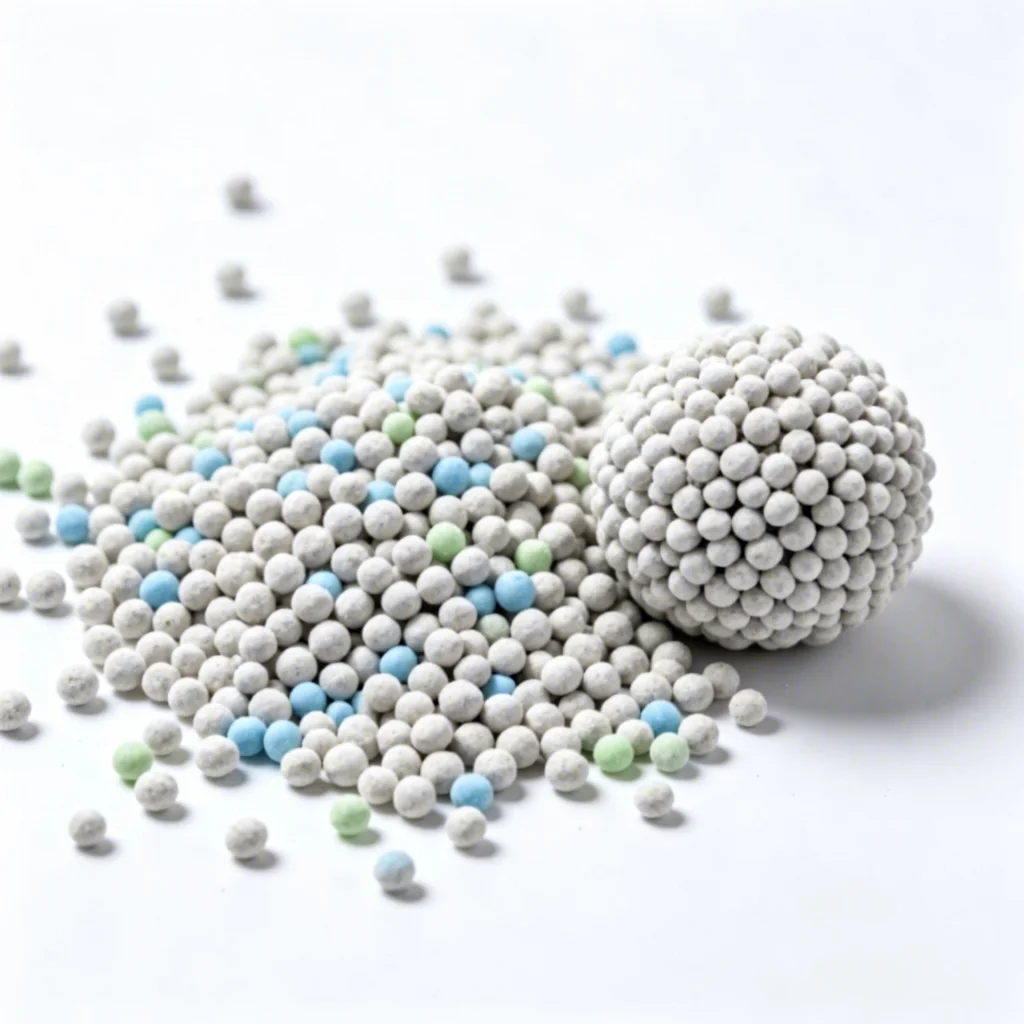
Bentonite is a clay rock dominated by montmorillonite, a swelling clay mineral. When montmorillonite meets water, it absorbs and expands — that expansion is what forms the clump. The rest of the story is purity, processing and moisture:
- Montmorillonite — the active clumping mineral; its content in the ore is the single most important quality number;
- Impurities — quartz, feldspar and other minerals dilute the ore; higher impurity means more dust and weaker clumps;
- Processing — drying, crushing, sieving and optional granulation (spherical or crushed); the same ore can yield different products;
- Additives — fragrance, baking soda or activated carbon are additions, not raw material — see our additives guide.
2. Why Mine Origin Matters
Bentonite deposits are not uniform. Surface ore (a few meters down) is exposed to weathering — it absorbs more moisture, carries more impurities and produces more dust in transport and use. Deep-layer ore, extracted tens of meters below surface, is denser and more consistent. Two suppliers both selling "natural bentonite" can be selling geologically different products.
Questions to ask the supplier:
- Where is the mine, and at what depth is the ore extracted?
- Do they own the mine or buy ore on the open market? (Own-mine suppliers control the ore; traders resell whatever they can buy.)
- Is the ore tested at the mine, at the factory, or both?
- Does the COA identify the mine and the batch?
3. Montmorillonite Content: The Number That Matters
"High quality" is a marketing phrase; "montmorillonite ≥50%" is a specification. The content decides how much absorption capacity you get per gram of litter — the economics of your bag.
| Spec Field | What It Means | Method |
|---|---|---|
| Montmorillonite content | Share of active swelling clay in the ore | XRD (X-ray diffraction) or methylene blue adsorption |
| Water absorption | How much water the clay holds per gram | Gravimetric, with conditions stated |
| Moisture content | Residual water after drying; too high = dust and clumping problems | Drying method, e.g. 105°C to constant weight |
| Swelling index | Volume increase when hydrated | Standard clay test, conditions stated |
Our bentonite TDS specifies montmorillonite ≥50% with the XRD/methylene blue method — the same value appears on every batch COA. If a supplier cannot state the method behind their "high montmorillonite" claim, the claim is unverified.
4. Sodium vs Calcium Bentonite
Two forms dominate global reserves:
- Sodium bentonite — absorbs water and expands strongly on contact; forms firm clumps without chemical processing. The preferred base for premium clumping litter.
- Calcium bentonite — larger reserves but weak natural swelling; typically needs activation with sodium carbonate to reach comparable clumping. Activation adds a process step whose consistency varies between suppliers.
Ask which form your supplier uses and whether the product is activated. The answer affects clumping strength, cost and batch consistency — and it belongs in the written specification, not in a sales call.
5. What the COA Should Show
A verifiable bentonite COA carries the batch number, the test methods and the results together. Minimum fields for raw-material verification:
- Montmorillonite content with method (XRD / methylene blue);
- Moisture content with drying method;
- Water absorption (gram per gram, conditions stated);
- Clump strength with the test protocol (liquid volume, contact time, temperature);
- Dust by a stated sieve or ISO method (e.g. ISO 8130);
- Heavy metals (lead, arsenic, etc.) — relevant for the EU and Middle East markets;
- Batch number, production date and mine/factory identification.
Our COA reading guide walks through each field; the TDS specification sheet shows the full parameter set we test per batch.
6. Container and Cost Implications
Bentonite is the heavy anchor SKU — the opposite of plant-based litter. Bulk density 0.85–1.05 g/cm³ means a 20' FCL reaches weight limits (~20–26 tonnes) before volume, while tofu (597 g/L) and cassava (~600–650 g/L) fill by volume first. Two consequences for buyers:
- Freight per bag, not per tonne, is the honest comparison between materials — the bulk density guide and liters vs kilograms explainer show the math;
- Mixed loads balance a container: bentonite (weight-fills) plus a plant-based line (volume-fills) in one 20' FCL is a standard pattern that cuts freight cost per unit — see the material comparison guide.
7. Our Own-Mine Setup, in Plain Terms
We mine our own bentonite in Liaoning instead of buying ore on the open market. That choice changes what we can promise: ore uniformity (deep-layer, 40–60 m), per-batch testing from the mine through the finished bag, and a stable montmorillonite spec that does not drift between purchase lots. It is also the reason our bentonite line carries the container loading sheet — we control the density side of the freight equation too.
None of this makes us "the best" — it makes our claims verifiable. Compare us against suppliers who cannot name their mine depth, their montmorillonite method or their batch COA.
8. Red Flags and the Buyer Checklist
Raw-material claims collapse fast when you put them next to documents. These are the phrases that should trigger a document request — and the checklist to run before any bentonite commitment.
| If a supplier says… | What to ask for |
|---|---|
| "High-grade bentonite" | Montmorillonite content with XRD / methylene blue method |
| "Natural, non-toxic, safe" | Heavy-metal test (Pb, As) with method and limits |
| "Low dust" | Dust value with sieve/ISO method, sample size and result |
| "Strong clumping" | Clump strength test protocol: liquid volume, contact time, temperature, pass criterion |
| "Long shelf life" | Moisture spec, packaging spec and any stability test |
| "Best quality in China" | A verifiable claim — mine name, depth, batch COA; adjectives are not documents |
The five-minute checklist before signing a bentonite order:
- Mine ownership and location — named, not "our partner's mine";
- Extraction depth — deep-layer ore or surface ore;
- Montmorillonite content with method on the COA;
- Moisture plus packaging spec that survives your sea route (35–45 days);
- Re-test rule and consequence if a batch falls out of spec.
Every item on this checklist is a document we provide with our own bentonite line — the TDS, the container loading sheet and the batch COA. If a supplier hesitates on any of the five, the hesitation is your answer.
9. Frequently Asked Questions
What is the raw material of bentonite cat litter?
Natural bentonite clay dominated by montmorillonite. Sodium bentonite absorbs and expands strongly (the basis of clumping); calcium bentonite needs activation. Ore purity and montmorillonite content set the quality ceiling before processing.
Why does montmorillonite content matter?
Montmorillonite is the active clumping mineral. Higher content means more absorption per gram and stronger clumps. A typical commercial spec is ≥50%, measured by XRD or methylene blue — with the method stated on the COA.
Is sodium or calcium bentonite better for cat litter?
Sodium bentonite is generally preferred for premium clumping litter: it absorbs and clumps naturally. Calcium bentonite needs sodium-carbonate activation, an extra variable between suppliers. Ask which form and which process your supplier uses.
How do I verify raw-material quality on a COA?
Check montmorillonite content with method, moisture with drying method, water absorption with conditions, clump strength with protocol, dust by stated method, and heavy metals. A COA without batch number or methods is not verifiable.
How much bentonite fits in a 20-foot container?
Bulk density 0.85–1.05 g/cm³ means a 20' FCL hits weight limits (~20–26 t) before volume — the opposite of plant-based litters. Freight per bag is the honest comparison; mixed loads balance a container.
Do you mine your own bentonite?
Yes — our own deep mine in Liaoning, extracted at 40–60 m. Deep-layer ore is more uniform and lower-dust; montmorillonite, density and clumping are tested per batch with the method on the COA.
- Montmorillonite ≥50%, bulk density 0.85–1.05 g/cm³, 36-month shelf life — Jinan Silk Pet bentonite TDS, verified per batch with method stated;
- Mine location (Liaoning) and extraction depth (40–60 m) — company operations data as presented on our bentonite product page and factory materials;
- CTI third-party batch reports — provided with the TDS on request (see Appendix 4 of the TDS pack);
- Sodium vs calcium bentonite behavior — industry-standard clay science; no market-size or ranking claims are made in this guide;
- No "best supplier" comparisons are made; claims are limited to what our own data supports.

Lisa Wei
Export Director, Jinan Silk Pet Technology Co., Ltd. 10+ years in cat litter OEM/ODM, raw-material sourcing, formula and container logistics for Latin America, the Gulf and Europe. Reviewed by the Jinan Silk Pet quality team.