How to Read a Cat Litter COA: 8 Indicators Importers Must Check Before Ordering
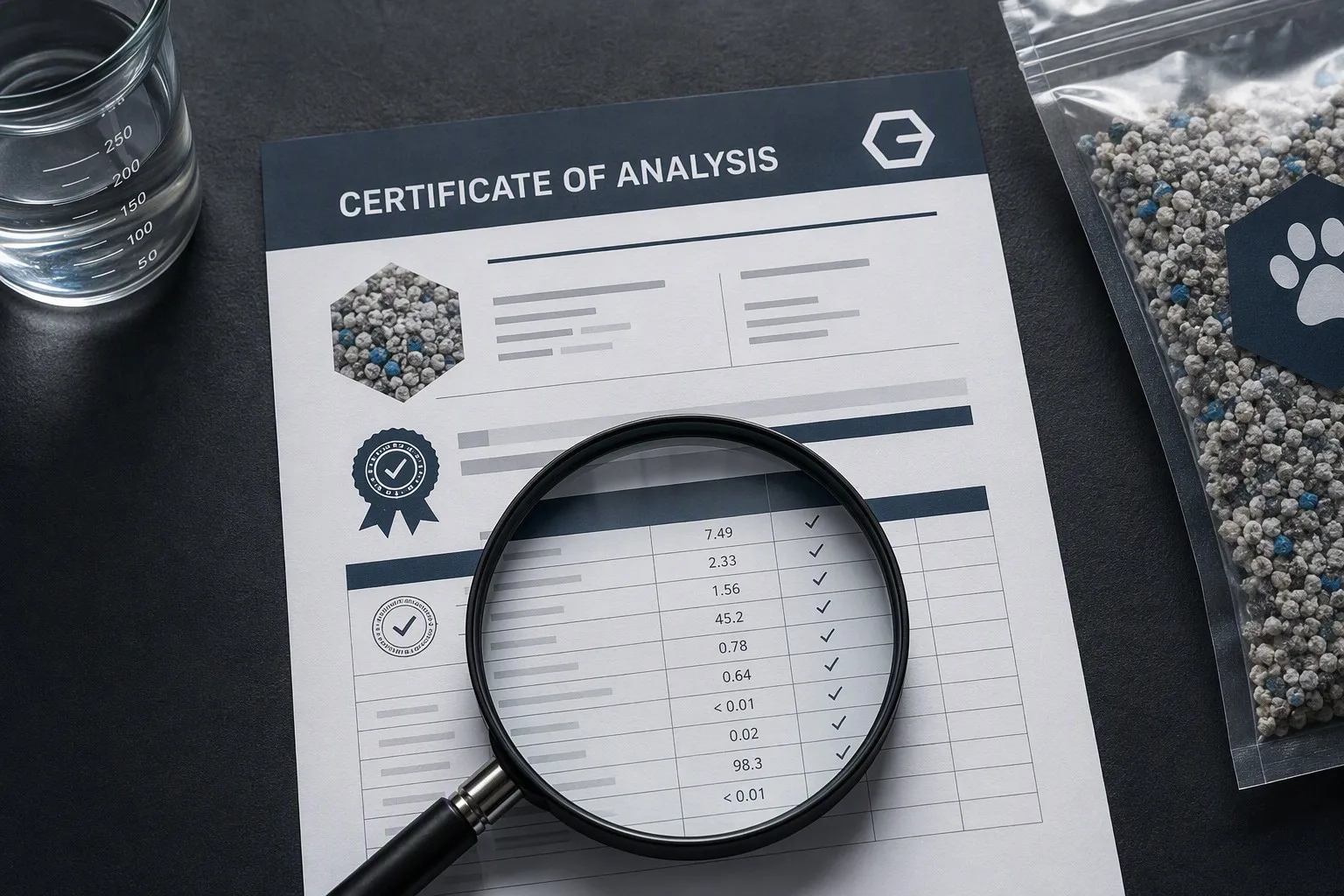
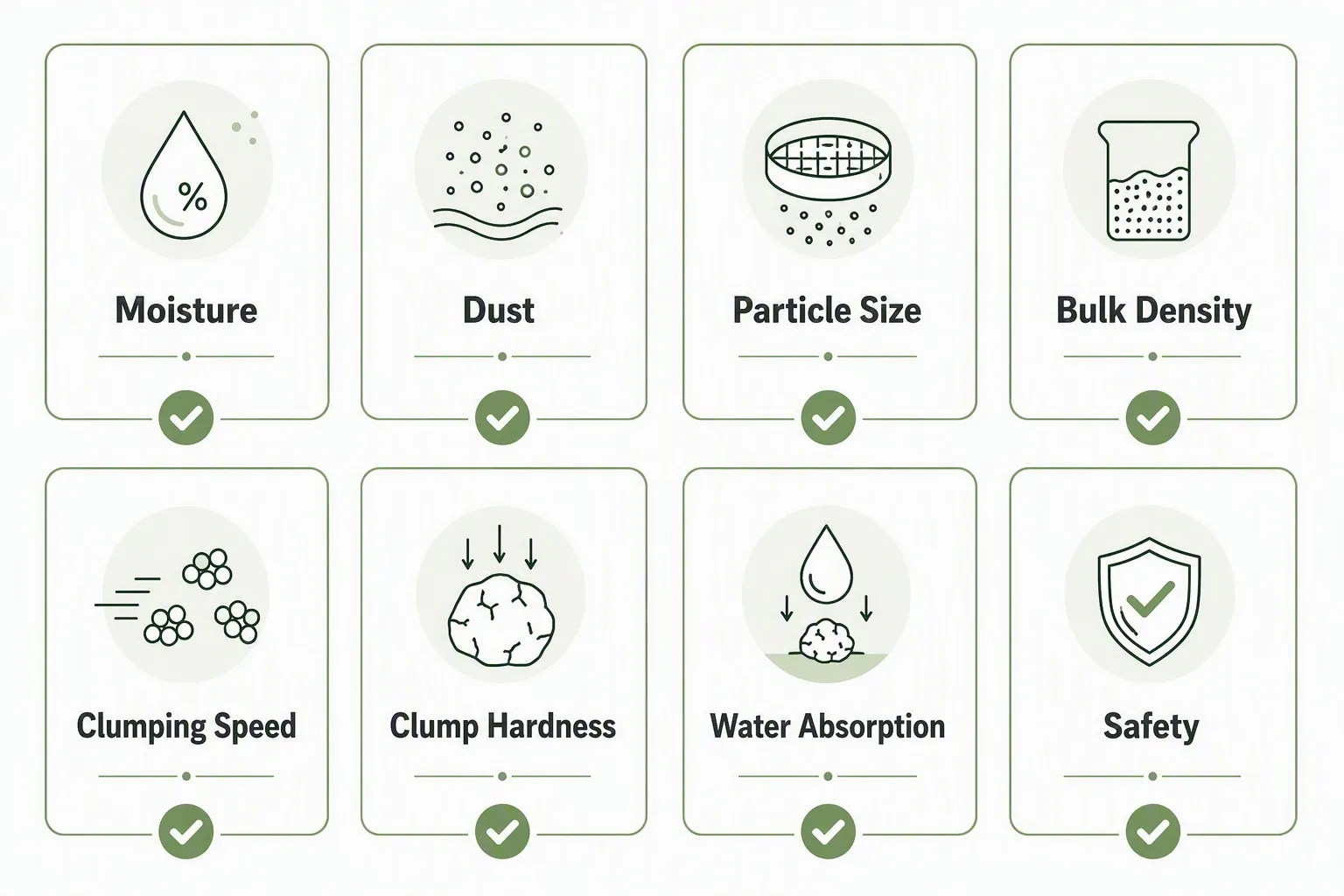
Definition. A COA (Certificate of Analysis) is the batch-level laboratory report for one production batch — not a generic spec sheet. 8 indicators to verify: moisture (<8% for plant-based, >10% is a freight red flag), dust (ISO 8130 sieving), bulk density (g/L), particle size, clumping speed, clump hardness, absorption, heavy metals. Every value must carry its method and batch number.
Who this is for: Cat litter importers, traders, and brand procurement and quality control teams.
1. What a COA Is, and Why It Matters More Than You Think
COA stands for Certificate of Analysis. In commercial practice, it serves as a documented record of agreed quality parameters between you and the factory.
After years in this business, one observation stands out: many importers negotiate aggressively over a ten- or twenty-dollar per-ton price difference, cycling through three rounds of bargaining — but the single document that proves product quality, the COA, gets a glance at the "Pass" stamp and then goes straight into a folder.
In practice, quality disputes between importers and suppliers frequently involve COA-related issues — not because the COA concept is flawed, but because buyers do not know what to look for on one. We have seen batch-A COAs photocopied and handed over as batch-B COAs. We have seen in-house spot checks presented as third-party certifications. We have seen COAs citing testing standards that do not exist.
Learning to read a COA is not an extra skill. It is a baseline requirement.
🔗 Related reading: Cat Litter Sourcing: Stop Obsessing Over Factory Price
2. Step Zero: Verify Identity Before Numbers
Before looking at a single data point, verify these three items:
| Verification Item | What to Check | Common Red Flags |
|---|---|---|
| Product Name & Model | Does it exactly match your contract? One letter off could be a different product. | Factory uses internal codes instead of the contracted product name |
| Batch Number & Production Date | Is this the same batch you sampled? Is the date the most recent test before container loading? | Batch-A COA photocopied for Batch-B |
| Packaging Specification | Does the packaging format on the COA match what you are actually shipping? (6 kg PE bag vs 10 kg kraft paper bag) | COA states 5 kg bags but actual shipment is 10 kg bags |
If these three items do not match, the data that follows — no matter how impressive — has nothing to do with your shipment. It could belong to a different batch, a different product, or even a different customer.
3. Indicator 1 — Moisture Content
Why it matters: Moisture content directly determines three things — clump hardness, mold risk, and dust level.
| Aspect | Detail |
|---|---|
| Common Detection Method | 105°C oven-dry method |
| Common Procurement Reference Range | Bentonite: ≤5%; Tofu: ≤8%; Cassava: 4%–8% |
| Method Traps | If it only says "rapid moisture meter" without calibration records, request supplementation |
| Quality Implication | Too high → mold during sea shipping + soft clumps. Too low → excessive dust |
Three questions to ask when reviewing a COA:
- What drying temperature and duration were used? (105°C for 2 hours is the most common condition)
- Was the sample taken directly from the production line or from the warehouse? (Warehouse samples may have absorbed ambient moisture)
- How many parallel samples were tested? (At least 3, and the report should show both the mean and deviation)
4. Indicator 2 — Dust Content
Why it matters: This is the most immediate sensory metric for end consumers. High-dust litters generate disproportionately more returns and complaints.
| Aspect | Detail |
|---|---|
| Common Detection Method | Vibration sieving + drop-height dynamic method (dual control) |
| Common Procurement Reference Range | Bentonite 200-mesh (<0.075 mm) pass rate: ≤1%; Tofu: ≤0.05% |
| Method Traps | If it only says "low dust" without numbers, request re-issuance with actual data |
| Quality Implication | Dust directly correlates with respiratory health concerns and fur adhesion (which feeds into tracking) |
Three technical details to confirm:
- What mesh size was used? 200-mesh (0.075 mm) is a common industry reference.
- Dry sieving or wet sieving? Dry sieving is typical for bentonite; wet sieving for plant-based.
- Was there a drop-height component? Static sieving alone is insufficient — refer to the pour-dust method in our low-tracking testing article.
5. Indicator 3 — Particle Size Distribution
Why it matters: Average particle size alone is not enough. The distribution range directly determines compatibility and tracking behavior.
| Aspect | Detail |
|---|---|
| Common Detection Method | Multi-level vibration sieving |
| What You Should See on the COA | A sieving curve graph (not two numbers), with D10, D50, and D90 values labeled |
| Method Traps | Reporting only "average particle size" without the distribution range |
| Quality Implication | Particles too fine → tracking and dust. Particles too coarse → poor clumping and reduced cat paw comfort |
Three key distribution parameters:
- D10: 10% of particles are smaller than this value. If this number is too low, there is a significant fines problem.
- D50: Median particle size — what consumers perceive as "coarse" or "fine."
- D90: 90% of particles are smaller than this value. If this number is too high, there are oversized granules in the batch.
Request the sieving curve graph (X-axis: particle size, Y-axis: cumulative passing percentage), not just two numbers. For products intended for automatic litter boxes, pay particular attention to the 1.5 mm–3.5 mm fraction percentage.
6. Indicator 4 — Bulk Density
Why it matters: This value directly affects your container load capacity and logistics cost.
| Material | Typical Bulk Density (g/cm³) | 20'FCL Load Reference |
|---|---|---|
| Bentonite | 0.85–1.05 | ~26 tonnes |
| Tofu | 0.55–0.70 | ~18 tonnes |
| Cassava | 0.55–0.65 | ~18 tonnes |
| Silica Gel | 0.40–0.50 | ~20 tonnes |
If a batch's density suddenly shifts — for example, bentonite dropping from 0.95 to 0.85 — the raw material source has likely changed or the moisture level is abnormal. A 5% density deviation on a 20-foot container translates to roughly 1.3 tonnes of product gained or lost, directly impacting your landed cost per unit.
7. Indicator 5 — Clumping Speed
Why it matters: Clumping speed directly determines user experience and ammonia control. Slow clumping = urine dispersal = contamination of the litter box base.
| Aspect | Detail |
|---|---|
| Common Detection Method | Stopwatch timer: 20 ml deionized water (25°C), drop, start timer, stop when scoopable intact |
| Common Procurement Reference Range | Bentonite: ≤3 seconds; Tofu: ≤5 seconds; Blended: ≤5 seconds |
| Method Criticality | Water volume, water temperature, and drop speed must be fixed — otherwise the data is not meaningful |
When reviewing the COA, confirm: what was the test water temperature? Cold water (<15°C) slows clumping speed and produces data that is not representative of normal use conditions.
8. Indicator 6 — Clump Hardness
Why it matters: This value directly corresponds to whether the clump shatters during scooping. Consumer complaints about "the clump falls apart when I scoop it" are almost always traced to this parameter.
| Material | Common Detection Method | Internal Factory Reference |
|---|---|---|
| Bentonite | Drop test (30 cm free fall) + pressure test (incremental weights until fracture) | No shatter on drop; fracture force ≥4 kg |
| Tofu | Pressure test (Texture Analyzer) | Fracture force ≥30 N |
| Blended | Depends on formulation; follow the corresponding material's method | — |
One test or both? Ideally both. The pressure test provides precision; the drop test reflects actual use — nobody presses a litter clump with calibrated weights, but every scooping motion is effectively a drop test.
9. Indicator 7 — Water Absorption
Why it matters: Reflects how much liquid a unit mass of litter can lock in. Higher absorption means slower consumption — each bag lasts longer per cat.
| Material | Typical Water Absorption Range | Common Detection Method |
|---|---|---|
| Bentonite | 80%–120% | Immersion / titration method |
| Tofu | 400%–500% | Immersion method |
| Cassava | 250%–350% | Immersion method |
| Silica Gel | 40%–80% (adsorption type) | Dynamic adsorption method |
Cassava litter in particular needs close attention to this parameter. Cassava's market positioning centers on "superior absorption." If water absorption is below 200%, the starch content or processing is likely compromised.
10. Indicator 8 — Microbiological & Chemical Safety
Why it matters: This is one of the most important compliance areas for international shipments, and the area where brand owners face the highest downside risk.
| Test Item | Applicable Materials | Standard Reference (for independent verification) | Key Concern |
|---|---|---|---|
| Aflatoxin B1 | Plant-based (tofu / cassava) | GB 2761; EU Reg. 1881/2006 | Storage mold from corn and bean-based raw materials |
| Total Bacterial Count | All types | ISO 4833 | — |
| E. coli | All types | ISO 16649 | Not detected (0 CFU/g) |
| Salmonella | All types | ISO 6579 | Not detected (0/25g) |
| Formaldehyde | All types | GB 18580; EN 717 | Residual from processing |
| Heavy Metals (Pb, As, Hg, Cd) | All types | EU Directive 2002/32/EC | Varies by destination market |
ⓘ Regulatory note: The standard references above are provided for readers' independent verification against their target market requirements. For products involving plant-based raw materials, confirm applicable testing items and thresholds with your destination market's regulatory framework — requirements differ significantly between the EU, GCC, and Latin American markets. Jinan Silk Pet does not claim that all listed standards are directly applicable to cat litter without confirming context with your compliance advisor.
Three questions to confirm on the COA:
- Are the testing standards cited on the COA applicable to your destination market's regulations, or are they general-purpose references?
- Does the testing body hold CNAS or ilac-MRA accreditation? (Look for the accreditation mark on the certificate)
- For plant-based litter, is aflatoxin B1 tested? This is non-negotiable — corn and bean-based raw materials are susceptible to mold during storage.
11. Three Critical Moments to Review a COA
| Timing | Action | Purpose |
|---|---|---|
| Sampling Stage | Receive the batch-specific COA with your sample | A sample without a COA is essentially blind — you do not know the conditions under which it was produced |
| Pre-Shipment | Request the pre-shipment COA for the production batch and retain a shipment reference sample | Prove that what went into the container is what the COA describes |
| Post-Arrival | Conduct your own sampling and send to a third-party lab; compare item-by-item against the pre-shipment COA | Verify the factory COA's accuracy independently |
We routinely advise clients to include a clause along these lines in their contracts:
"A third-party test report issued by a CNAS/ilac-MRA accredited laboratory at the destination port shall serve as one of the bases for final quality settlement. If destination-port test results deviate from the pre-shipment COA by more than approximately 20% on any of the key parameters — moisture content, dust content, or clump hardness — the buyer reserves the right to request a price adjustment or return of goods."
Reliable factories are not afraid of independent testing. If a factory resists third-party verification, that resistance itself is worth investigating.
12. Frequently Asked Questions
What does a COA mean for cat litter?
A COA (Certificate of Analysis) is the batch quality document for a cat litter shipment. It records the physical and chemical parameters measured for that batch — density, moisture, dust, clumping and heavy metals — with the test methods and the batch number. It is how you verify that the product you receive matches the spec you ordered; a COA without a batch number or a stated method is not a verifiable document. For the full set of parameters we test per batch, see our TDS specification sheet, and for how ingredients and claims are disclosed alongside the COA, see our ingredient disclosure guide.
What is the difference between a COA and an MSDS?
A COA records product quality parameters (physical and chemical). An MSDS (Material Safety Data Sheet) records product safety information — hazards, first aid measures, transport classification. They are complementary documents; may be requested during import procedures depending on destination market requirements. COA covers quality; MSDS covers safety. Do not confuse them.
Is a third-party COA more reliable than a factory COA?
A third-party COA is significantly more reliable, provided the testing body holds CNAS or ilac-MRA accreditation. Factory in-house COAs can be used as reference but should not be the sole basis for acceptance. If a factory claims "we have third-party testing," verify the accreditation mark on the certificate and check the report number — CNAS-accredited reports are verifiable on the CNAS website.
What should I do if the destination-port test results differ from the pre-shipment COA?
Differences within approximately 10% generally fall within normal batch variation and inter-laboratory deviation. Differences exceeding roughly 20% on key parameters should trigger the claim process. This is why a contractual clause specifying destination-port third-party testing as a settlement basis is critical — without contractual support, COA disputes can only be resolved through negotiation.
What additional COA indicators should I check for plant-based cat litter?
Aflatoxin B1 should be considered a critical check for plant-based litters such as tofu and cassava. Microbiological indicators (total bacterial count, E. coli, Salmonella) are also more critical for plant-based products than for mineral litters. Some markets such as the EU may also require GMO declarations. Always confirm applicable requirements against your destination market's regulations. For the complete specification sheet and COA parameters, review our cassava cat litter specification and COA overview.
Which COA indicators matter most for each material type?
- Bentonite: Moisture, dust, clumping speed, clump hardness — detailed test methods are covered on our bentonite quality test methods page.
- Tofu: Moisture (mold prevention), aflatoxin B1, clumping speed, pellet hardness.
- Cassava: Water absorption, aflatoxin B1, electrostatic properties.
- Silica gel: Bulk density, water absorption, particle size distribution.
- Blended: All component indicators should be checked, and the factory should provide the blend ratio specification.
Cat Litter Procurement Specification & COA Quick-Reference Checklist
One reference asset covering all six material lines and the eight COA indicators — built for procurement teams comparing factory quotes, verifying batch documentation, and citing sourcing benchmarks.
1. Key Specifications by Material
| Material | Clumping | Dust | Absorption / Odor | Bulk Density | MOQ / Load |
|---|---|---|---|---|---|
| Tofu | ≤5s | ≤0.05% | Absorption 400–500%; odor 7–10 days | 0.55–0.70 g/cm³ | 18 T (1×20′) |
| Cassava | ≤4s | ≤0.05% | Absorption 250–350% (positioned 300%+) | 0.55–0.65 g/cm³ | 18 T (1×20′) |
| Bentonite | ≤3s | ≤0.1% | Absorption 80–120%; clump fracture ≥4 kg | 0.85–1.05 g/cm³ | 26 T (1×20′) |
| Silica Gel Crystal | Non-clumping | ≤0.05% | 2–4 weeks/bag; adsorption 40–80% | 0.40–0.50 g/cm³ | 38 T (1×40′) |
| Mixed Blend | Custom (≤5s) | ≤0.05% | Formula-dependent; custom blend ratios | Varies | 18 T (1×20′) |
| Health Monitoring | Fast result | ≤0.05% | pH alert + color change; urinary screening | Varies | 18 T (1×20′) |
2. The 8 COA Indicators at a Glance
| # | Indicator | Common Detection Method | Procurement Reference | What It Tells You |
|---|---|---|---|---|
| 1 | Moisture Content | 105°C oven-dry | Bentonite ≤5%; Tofu ≤8%; Cassava 4–8% | Mold risk, clump hardness, dust |
| 2 | Dust Content | Vibration sieving + drop-height | Bentonite 200-mesh ≤1%; Tofu ≤0.05% | Returns, respiratory concerns, tracking |
| 3 | Particle Size Distribution | Multi-level sieving | D10 / D50 / D90 curve, not averages | Auto-box compatibility, tracking |
| 4 | Bulk Density | Weight / volume | 0.40–1.05 g/cm³ by material | Container load, landed cost |
| 5 | Clumping Speed | Stopwatch, 20 ml water (25°C) | Bentonite ≤3s; Tofu ≤5s; Blended ≤5s | User experience, ammonia control |
| 6 | Clump Hardness | 30 cm drop + pressure test | Bentonite fracture ≥4 kg; Tofu ≥30 N | Clump shattering during scooping |
| 7 | Water Absorption | Immersion / titration | Tofu 400–500%; Cassava 250–350% | Bag longevity per cat |
| 8 | Microbiological & Chemical Safety | ISO 4833 / 16649 / 6579; GB/EU refs | E. coli: 0 CFU/g; Salmonella: 0/25g; aflatoxin B1 for plant-based | Compliance, brand liability |
3. Before You Sign — 7-Point Verification
| # | Check | Why It Matters |
|---|---|---|
| 1 | Product name & model match the contract exactly | One letter off could be a different product |
| 2 | Batch number & production date match the sampled batch | Batch-A COA for Batch-B is the most common fraud |
| 3 | Packaging spec on the COA matches the actual shipment | 6 kg vs 10 kg changes your unit economics |
| 4 | Testing lab holds CNAS / ilac-MRA accreditation | Report numbers verifiable on the CNAS website |
| 5 | Sieving curve (D10 / D50 / D90) included for particle size | Averages alone hide fines problems |
| 6 | Aflatoxin B1 tested for plant-based litters | Non-negotiable for tofu and cassava |
| 7 | Destination-port third-party testing clause in the contract | Settlement basis if values deviate >20% |
Free PDF — specifications table, 8-indicator COA reference, and 7-point verification in one page.
Pair this checklist with our commercial pages: Private Label OEM Factory · Bentonite Cat Litter (Own Mine) · Request a Quote
13. Get the COA Verification Checklist and Redacted Sample
If you need a redacted real COA sample and a printable 8-indicator verification checklist to use during inspections, contact our product engineering team and specify which material type you are focused on:
- Bentonite cat litter
- Tofu cat litter
- Cassava cat litter
- Blended cat litter
- Silica gel crystal
We will provide recent internal quality control report templates (with key figures redacted) and walk you through each indicator's applicability to your target market's regulatory requirements.
Health Monitoring Cat Litter — pH and occult blood test kit
CNAS — China National Accreditation Service (lab report verification)
ILAC — International Laboratory Accreditation Cooperation (ilac-MRA)
SilkPet Tofu Cat Litter — CTI third-party test references (bulk density 597 g/L, clumping 96.1%)
Cat Litter Bulk Density — how to read density on a COA (loose vs. tapped, batch linkage)
Cat Litter MOQ Explained — batch COA and MOQ both belong in the RFQ file
SilkPet Bentonite Cat Litter — own-mine batch data