Cat Litter Ingredients: What OEM Suppliers Must Disclose for Private Label
Cat litter is a three-layer system: a base material that absorbs, a binder or clumping agent that holds waste in a scoopable clump, and functional additives that change the user experience — odor control, fragrance, color, anti-static or pH indicators. The first layer is almost always disclosed; the second and third layers need documented functions and ranges from the supplier.
Who this is for: Importers and brand owners developing a private-label cat litter — the procurement, quality and packaging decision-makers who need to know which ingredients are trade secrets and which must be disclosed, and what documents to attach to every claim on the bag.
1. The Direct Answer: What Cat Litter Is Made Of
When an EU or US retailer, or a due-diligence questionnaire, asks “what is your litter made of?”, the correct answer has three layers — and each layer carries its own evidence requirement:
1.1 Base Material
The absorbent core. Clay (bentonite — sodium or calcium type), plant fiber (tofu/pea fiber, cassava/tapioca), wood fiber, or silica gel. The base material determines density, absorption and weight-vs-volume container economics. Google Trends shows “what is cat litter made of” was the top rising related query in the past 24 hours (+80%, a relative index, not absolute search volume) — the question is active, and the answer belongs in your supplier file.
1.2 Binder or Clumping Agent
What turns absorbent granules into a scoopable clump. Natural plant binders (starches, gums, plant fiber) are common in plant-based litters; bentonite clumps through its own clay chemistry, so a “binder” may be minimal or absent. Clumping litters and non-clumping litters differ here, and the difference must be in the spec, not discovered at the first pallet.
1.3 Odor-Control Additives
Adsorption agents, neutralizers and masking compounds — the layer that carries most of the “odor control” claim. Our odor-control additives guide covers the mechanisms and why the claim needs a defined measurement. For disclosure: the additive function and active substance must be named; the trade-secret ratio can stay confidential.
1.4 Fragrance, Color and Functional Additives
Fragrance oils, colorants, anti-static treatments, pH indicators. These change the product experience and the packaging claims. Their disclosure requirement is binary-plus: present or absent, which class, and — if a claim depends on them (e.g. a pH indicator in health-monitoring litter) — the test behind the claim.
2. Ingredient Disclosure by Cat Litter Type
Each product family has a typical disclosure profile. What is public, what needs documents, and what stays confidential:
| Litter type | Typical base material | Typical binder / additives | Public by default | Needs documents |
|---|---|---|---|---|
| Bentonite / clay | Sodium or calcium bentonite from a named mine region | Minimal binder; optional fragrance, dust-reduction coating | Base material, density, particle size, dust range | Mine source, batch COA, additive SDS |
| Tofu / pea fiber | Okara or pea fiber | Starch or gum binder, optional baking soda / odor additives | Base material, flushability positioning, density | Binder type, additive list, flush/dispersion test where claimed |
| Cassava / tapioca | Cassava starch and fiber | Plant binder, moisture-control additives | Base material, absorption claims, density | Binder and additive list, moisture and clump test data |
| Wood / paper | Wood fiber (e.g. spruce, fir, pine — see ökocat's statement below), recycled paper | Optional binder, odor additives | Base material, renewable positioning | Species/source statement, additive list |
| Silica gel / mixed | Amorphous silica gel, or a blend (e.g. tofu + bentonite) | Dust-free coating, fragrance, or per-blend formulation | Base material(s), blend ratio class | Coating SDS, blend spec, batch COA |
Two brand statements illustrate the disclosure depth in the market today: Fresh Step's FAQ states its clumping and non-clumping litters are made primarily of clay, and ökocat's FAQ states its litter is made from a mix of spruce, fir and pine. Both are company material statements — useful benchmarks for what a brand discloses publicly, but not full recipes and not third-party verification.
3. What an OEM Supplier Should Disclose
3.1 Ingredient Name, Function and Range
For every ingredient: the name, the function, and a percentage range (not the exact ratio). If a supplier refuses to name a functional additive — as opposed to protecting its ratio — that is a red flag. A functional ingredient that cannot be named cannot be tested, recalled or audited.
3.2 Country/Source and Supplier Traceability
Where the base material comes from and how far the chain is documented. For bentonite this means the mine region and the mine/supplier chain; for plant fiber, the source and processing. SilkPet's bentonite page states our own-mine raw material; the products overview publishes the six product lines and main materials — first-party statements that connect to batch documents for specific quality conclusions.
3.3 Added vs. Naturally Occurring Substances
The distinction that prevents most packaging errors: a fragrance or binder added in production is different from minerals naturally present in the clay, and from trace elements in plant fiber. The supplier declaration should document which substances are added and which are inherent — it changes what your COA must test and what your label may claim.
4. Documents Buyers Should Request
4.1 Batch COA
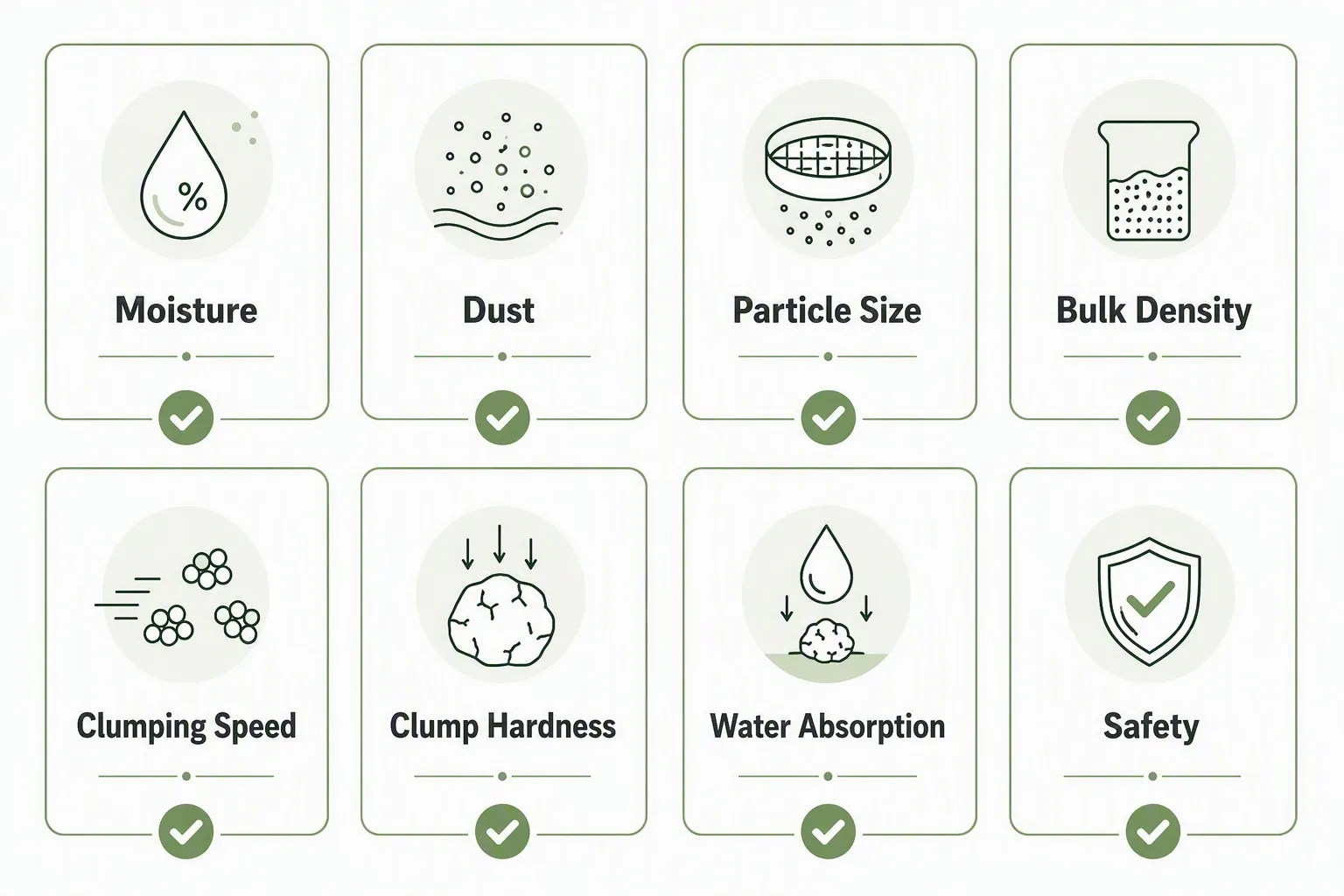
The batch certificate of analysis with test methods stated — not a marketing certificate. Our COA guide walks through the eight indicators and the seven-point verification so you can tell a real batch file from a template.
4.2 SDS and Technical Data Sheet
The Safety Data Sheet covers handling and hazard information for the finished product and its additives; the Technical Data Sheet covers physical specifications (density, particle size, moisture, dust). They answer different questions — one is safety, one is spec — and neither replaces the COA.
4.3 Supplier / Material Declaration
A written declaration of the ingredient list: name, function, range, country of origin, and added vs. naturally occurring status. This is the document your label and your claims are built on.
4.4 Allergen, Food-Grade or Certification Evidence
Only where you intend to make the claim. “Food-grade”, “allergen-free” or any certification statement needs its own evidence attached to the batch. If the file does not exist, the claim does not go on the bag — see our claims boundary guide for the same discipline applied to biodegradable and flushable wording.
5. What Can Remain Confidential Under NDA
5.1 Exact Ratios vs. Safety-Critical Disclosure
The exact percentage of each ingredient is a trade secret and can stay under an NDA. What cannot stay confidential is anything safety-critical: allergens, substances of concern, and anything that changes the hazard profile. Confidentiality protects the recipe; it does not protect the safety information. The line is drawn in the NDA, not after an incident.
5.2 Controlled Specification and Change Notification
The disclosure framework only works if the spec is controlled. Your contract should include a change-notification clause: any change to base material, binder or additive triggers re-disclosure and re-testing of the batch COA before shipment — and a sample for your approval. A formula that can change silently is a formula you cannot audit.
6. Packaging Claims That Need Evidence
6.1 Natural, Biodegradable and Flushable
“Natural” describes the base material, not the product — a plant-fiber litter still contains binders and additives. Biodegradable and flushable claims each carry their own test or composition burden. The full boundary is in our biodegradable and flushable guide; the principle here is the same: the claim goes on the bag only when the file is in the folder.
6.2 Dust-Free, Odor Control and Antibacterial
“Low dust” requires the dust test method and reference range; “odor control” requires a defined ammonia or odor measurement; “antibacterial” requires a named test standard and result. Our low-tracking verification guide shows the method-first approach for the physical claims. No method, no claim.
7. Ingredient and Additive RFQ Table
Send this table to every shortlisted supplier. It forces a like-for-like comparison and makes the disclosure boundary visible before the NDA conversation:
| Item | Ask the supplier to state | Document to attach | Can it stay confidential? |
|---|---|---|---|
| Base material | Type, source country/region | Material declaration | No — public layer |
| Binder / clumping agent | Type, function, % range | Material declaration, TDS | Exact % only, under NDA |
| Odor-control additives | Function, active substance | SDS, technical sheet | Ratio yes; substance no |
| Fragrance / color | Present/absent, class | Material declaration | Composition yes; presence no |
| Anti-static / pH / functional | Function, claim test | Test report | Claim evidence no |
| Batch evidence | COA per batch, methods | Batch COA | No |
| Change control | Notification + re-test clause | Contract clause | No |
8. Request a Batch-Specific Formula Disclosure Pack
For a signed project, SilkPet provides a disclosure pack: batch COA with stated methods, material specifications from our raw-material and packaging suppliers, SDS where applicable, and a material declaration with ingredient name, function and range. Exact ratios stay under NDA, and a change-notification clause is written into the supply agreement. That is the framework this article recommends — and it is the same framework we operate under.
9. Frequently Asked Questions
What is cat litter made of?
Cat litter is a three-layer system: a base material that absorbs (clay such as bentonite, plant fiber such as tofu or cassava, wood fiber, or silica gel), a binder or clumping agent that holds waste in a scoopable clump, and functional additives (odor-control agents, fragrance, color, anti-static or pH indicators). The first layer is almost always disclosed; the second and third layers need documented functions and ranges from the supplier.
Do I need the full formula disclosed for private label?
No — and a serious supplier will not hand over its exact formula in a quotation. What you need is the disclosure of each ingredient by name, function and percentage range, with safety-critical information always disclosed regardless of confidentiality. The exact ratio can remain a trade secret under an NDA, but the range and the function must be written into the controlled specification.
What documents should I request from a cat litter OEM?
Four document types: a batch COA with test methods stated, an SDS and a technical data sheet for the product, a supplier or material declaration (ingredient list, function, range, country of origin), and — only where you intend to make the claim — allergen, food-grade or certification evidence. Each document serves a different claim, and one certificate does not replace the others.
Is 'natural' on the bag enough?
No. 'Natural' describes the origin of the base material, not the whole product: a plant-fiber litter still contains binders and additives. If you print 'natural', 'biodegradable' or 'flushable', the claim needs the same evidence discipline as any other claim. See our biodegradable and flushable claims guide for the boundary.
Are food-grade claims verifiable?
Only with per-batch evidence. A food-grade or food-contact statement requires the underlying test or certification to be attached to the specific batch, not to a marketing page. If a supplier cannot produce the file for your batch, the claim should not go on the packaging. SilkPet does not claim food-grade without the corresponding documents.
Can a supplier keep the recipe confidential?
Yes, through an NDA and a controlled specification. The supplier discloses ingredient names, functions and ranges; the exact ratios stay under NDA. The contract should also include a change-notification clause: any change to base material, binder or additive triggers re-disclosure and re-testing of the batch COA before shipment.
Why does the bag say one material but the COA shows additives?
Because added substances are different from naturally occurring ones. A bag can say 'bentonite' while the COA lists a fragrance or a binder that was added in production — and the clay itself contains naturally occurring minerals and trace elements. The added vs. naturally occurring distinction is exactly what the supplier declaration should document.
What evidence does Jinan Silk Pet provide with an ingredient disclosure pack?
For a signed project we provide batch COA with stated test methods, material specifications from our raw-material and packaging suppliers, SDS where applicable, and a material declaration covering ingredient name, function and range. Exact formula ratios remain under NDA, and we do not publish full formulas publicly.
Fresh Step — Official FAQ (clay-based material statement)
ökocat — Official FAQ (spruce, fir and pine material statement)
Google Trends — “what is cat litter made of” +80% (relative, past 24 hours)
SilkPet Products Overview — six product lines and main materials (first-party)
SilkPet COA Guide — eight indicators and seven-point verification
SilkPet Odor Control Additives Guide — mechanisms and claim measurement
SilkPet Claims Boundary Guide — biodegradable and flushable wording