Why Mixed Blend? The Strategic Advantage
Single-material cat litters have inherent trade-offs. Tofu clumps moderately but is lightweight. Bentonite clumps hard but is heavy and non-biodegradable. Cassava absorbs 300%+ but isn't flushable. Activated carbon controls odor but can't clump alone. Mixed blend litters eliminate these compromises by combining the strengths of each material while neutralizing their weaknesses.
For brand owners and distributors, mixed blend represents a defensible competitive position. Any competitor can source straight tofu or straight bentonite. But your specific 58% Cassava / 42% Tofu blend at 1.8mm diameter with peach + green tea fragrance and pH detection particles? Only you have it. This is the most durable moat in the cat litter category.
B2B Insight: Mixed blends with Tofu+Bentonite account for ~70% of global blended litter orders (Japan and Korea lead). The fastest-growing segment is Tofu+Activated Carbon blends, driven by urban apartment dwellers. Health-monitoring blends (pH + blood test particles) are the emerging premium frontier — 3 of the top 10 crowdfunded pet products in 2025 included urine-health detection features.
Behind Every Custom Formula: Rigorous Lab Testing
Each blend variant goes through a structured in-house testing protocol before any sample leaves our facility. Below is a representative view of our quality infrastructure — from raw material analysis to finished blend certification.
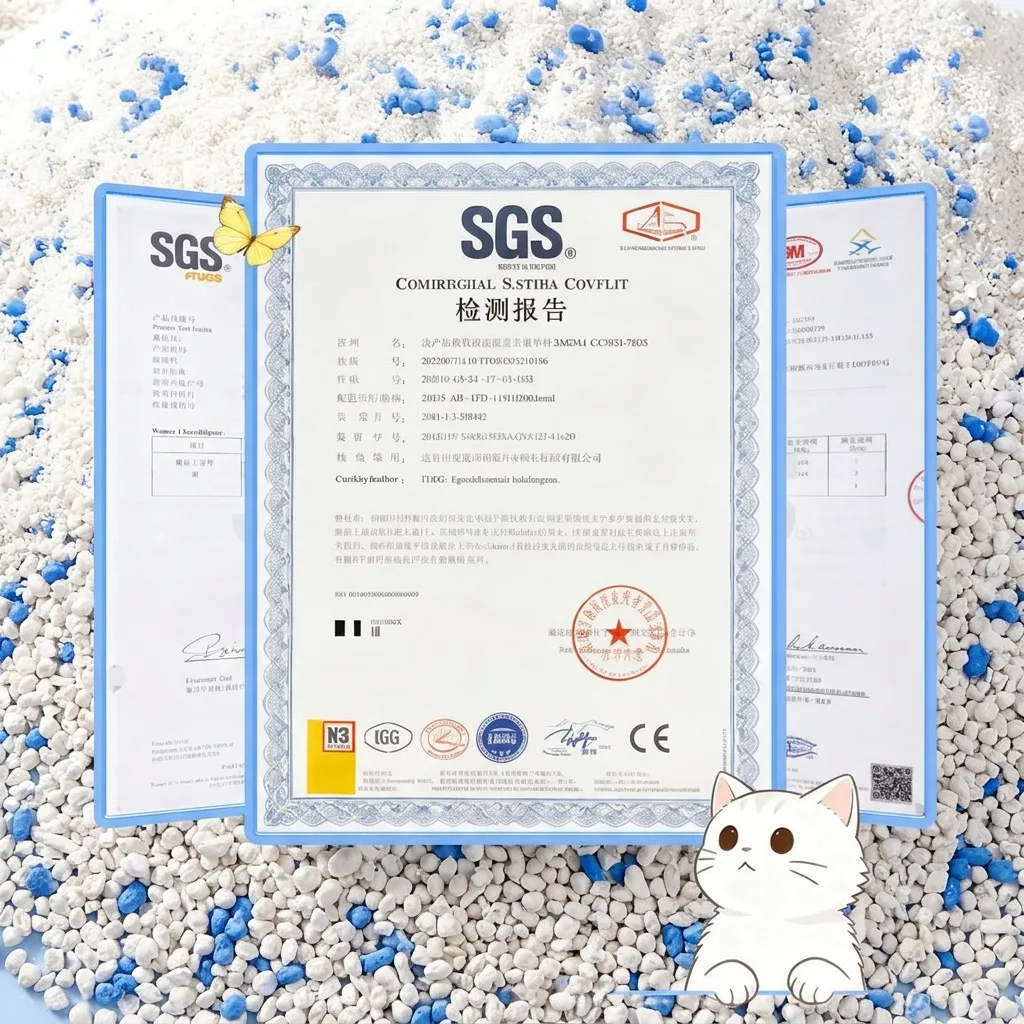
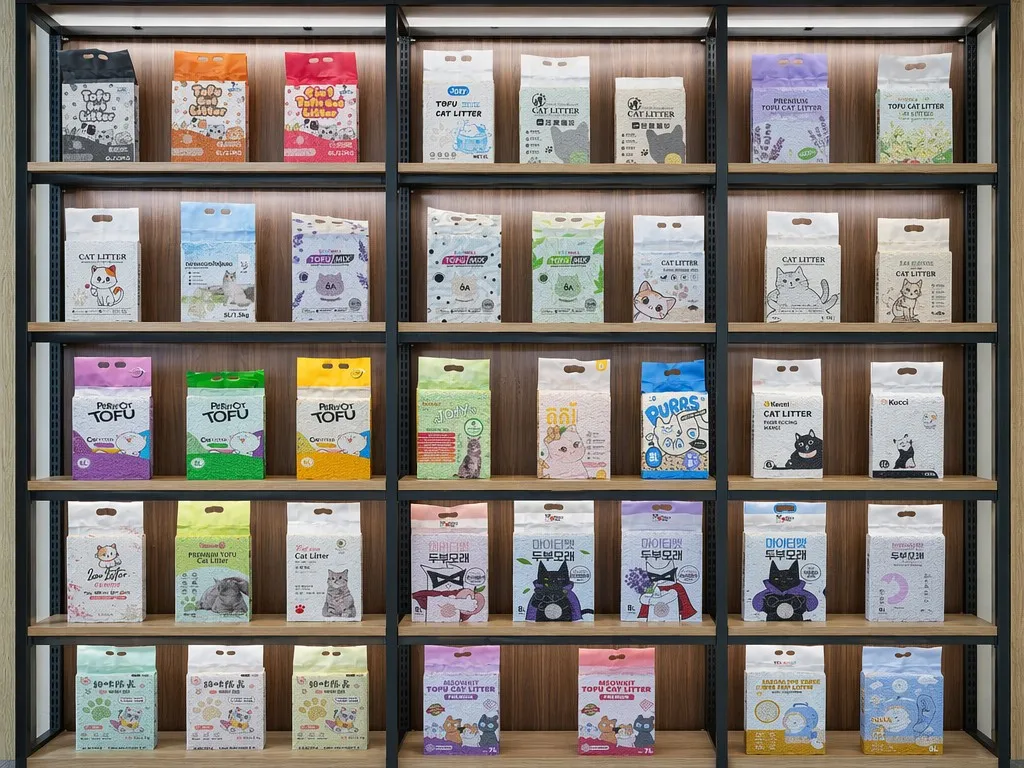
Left: SGS third-party lab report for blend formula verification (heavy metals, allergen panel, microbiological). Right: OEM output wall — each package represents a custom formula developed for a specific client, brand, and market.
OEM Process: From Brief to Batch in 4 Weeks
Our formula development process is designed for speed, transparency, and zero upfront risk. You don't commit to production until you've tested and approved physical samples. Every step can be protected under a mutual NDA.
Share Your Vision
Tell us your target market, retail price point, key performance goals (clumping strength, eco claims, flushability), and any competitor benchmarks. No technical knowledge required — we translate your business needs into an engineering brief.
R&D Formula Engineering
Our lab proposes 2–3 blend variants with predicted performance data. We explain trade-offs transparently: ratio vs. cost, eco claims vs. clumping speed, weight vs. absorption. You choose which variants to sample, or ask us to adjust.
Sample Production & Review
Physical samples produced at pilot scale and express-shipped. Test with real cats, your QC team, or consumer panels. COA provided with each batch. Up to 2 rounds of revision samples included at no charge.
Formula Lock & NDA
Final ratio, granule specs, fragrance, packaging, and any functional additives are locked into a Formula Specification Sheet. NDA signed for exclusivity protection. Your formula is never shared with any other client.
Mass Production & QC
Gravimetric dosing (±2% ratio accuracy), low-RPM ribbon blending to prevent segregation, 5-point batch uniformity test. Moisture, dust, clumping, and microbiological panels run before packaging authorization.
Pre-Shipment & Logistics
Final inspection: blend uniformity re-verified, packaging integrity checked, COA issued. FOB Qingdao/Tianjin. Container loading photos provided. Full documentation package including MSDS, SGS reports, and REACH compliance where applicable.
Full-Spectrum OEM Customization: Every Variable Is Yours
Unlike single-material litters where specifications are largely fixed, mixed blends give you control over every performance dimension. Below is the complete range of configurable parameters we offer — from the expected (packaging, fragrance) to the advanced (health-monitoring particles, region-specific moisture targets).
Three Standard Commercial Formulas
Instead of “we can mix anything,” most private-label programs start from one of three standard formulas — each solving a different retail problem:
| Formula | Solves For | Best Channel |
|---|---|---|
| Tofu + Bentonite | Clumping strength at a plant-based price point: bentonite adds firm clumps, tofu adds the flushable/premium story | Value-to-mainstream retail, automatic boxes |
| Cassava + Tofu | Soy-free premium positioning with strong clumping; the white cassava base shows urine color changes | Premium retail, allergen-aware markets — see our dedicated formula page |
| Tofu + Bentonite + Odor-Control Additive | Ammonia is the #1 complaint in multi-cat households — add activated carbon or zeolite granules | Multi-cat households — see our odor-control additives guide |
Every formula ships with the ingredient statement, batch COA and container plan — the evidence pack above.
🧪 Blend Ratio Engineering
- 2-component blends: Tofu+Bentonite, Cassava+Tofu, Tofu+Carbon, Pine+Tofu, Bentonite+Cassava
- 3-component blends: Tofu+Bentonite+Crystal, Tofu+Cassava+Carbon
- 4-component blends: Tofu+Bentonite+Crystal+Carbon (advanced)
- Ratio range: 20%–80% per component
- Granule size matching: 1.5mm / 2.0mm / 3.0mm across components to prevent segregation
- Custom pellet length: 8mm / 15mm / custom
Looking for a dedicated cassava–tofu formula? See our cassava–tofu custom formula page — ratio, granule, fragrance and packaging defined before quotation, with formula file, batch COA and sample.
📦 Packaging Customization
- Bag sizes: 1.25kg / 2.5kg / 5kg / 6kg / 7kg / 10kg / 15kg / 20kg
- Bulk: Ton bags (jumbo bags), 500kg–1000kg
- Formats: Stand-up pouch (zipper), Kraft paper bag, PP woven bag, Vacuum-sealed brick pack, Pillow bag, Flat-bottom box pouch
- Materials: PE laminate, Aluminum foil laminate, Kraft paper, Biodegradable film
- Printing: Gravure (up to 8 colors), Digital (short runs), Matte/Gloss lamination, Spot UV
- Custom die-cut handles, tear notches, resealable zippers
- Inner bag options: PE liner, Aluminum moisture barrier
🌸 Fragrance & Scent Engineering
- Unscented (hypoallergenic base)
- Natural botanical: Green Tea, Lavender, Peach, Rose, Lemon, Apple, Baby Powder, Ocean Breeze
- Custom fragrance: We source from IFF/Givaudan-approved fragrance houses to your specification
- Fragrance intensity: Light / Medium / Strong (controlled by additive %)
- Fragrance release technology: Micro-encapsulated (longer-lasting) or Direct-mix (immediate)
- Deodorizing additives: Activated carbon granules, Zeolite powder, Baking soda infusion, Nano-silver antibacterial
🩺 Health Monitoring Additives
- pH Detection Granules: Color-change particles that react to urine pH. Normal (6.0–6.5): no change. Alkaline (>7.0): turns blue. Acidic (<5.5): turns yellow/orange. Early screening for UTIs, struvite crystals, and kidney stress.
- Occult Blood Test Particles: Detect hemoglobin as low as 0.1% concentration. Turn blue within 3 seconds of contact with trace blood in urine. Color remains visible for 7+ days. Early detection of Feline Lower Urinary Tract Disease (FLUTD), bladder stones, and urinary tract infections.
- Combined pH+Blood Monitoring: Dual-indicator particles in one blend — the most comprehensive at-home cat health screening available in cat litter format.
- Additive ratio: 5%–25% of total blend (configurable)
- All detection reagents are non-toxic, food-grade safe, and independently SGS-verified.
🎨 Visual & Color Customization
- Natural color blend: Tofu (off-white) + Bentonite (grey) = golden-grey; Cassava (cream) + Tofu = warm cream
- Custom dyed granules: Any Pantone-matched color for brand signature
- Multi-color crystal particles: Blue, Pink, Green, Purple, Yellow — for premium shelf differentiation
- Activated carbon: Dramatic black-white contrast — top-performing visual in e-commerce photography
- Color-fastness tested: No dye bleeding when wet (SGS migration test)
📐 Granule Engineering
- Diameter: 1.5mm / 2.0mm / 3.0mm (matched across blend components)
- Shape: Cylindrical pellet (standard), Irregular crushed (natural look)
- Pellet length: 5mm–20mm (shorter = less tracking, longer = lower dust)
- Density tuning: 0.55–0.75 g/cm³ (affects shipping weight and consumer carry feel)
- Hardness: ≥30N–50N (higher = less breakage dust, lower = softer paw feel)
🌍 Region-Specific Engineering
- Moisture target: ≤8% (tropical/humid markets), ≤10% (temperate), ≤12% (EU dry climate)
- Dust spec: ≤0.05% (premium/medical), ≤0.1% (standard), ≤0.3% (value blend with bentonite)
- Clumping target: ≥3.5 kg bond strength (bentonite-heavy), ≥30N (tofu/cassava-heavy)
- Flushability claim: Only for ≥80% tofu-based blends with ≤15mm pellet length
- Biodegradability cert: OECD 301B available for plant-based blends >70% plant content
- Compostability: EN 13432 testing available on request
📋 Documentation Package
- Formula Specification Sheet (your locked blend blueprint)
- COA — Certificate of Analysis (per batch)
- SGS Third-Party Test Report (heavy metals, allergens, physical performance)
- MSDS — Material Safety Data Sheet (blended product composite)
- REACH Compliance Declaration (EU SVHC confirmation)
- NDA — Formula Exclusivity Agreement (mutual, legally binding)
- ISO 9001 / HALAL / HACCP certificates
- Allergen verification report (soy-free, gluten-free confirmations)
Proven Formula Architectures — Your Starting Point
These battle-tested blend architectures have been refined through hundreds of client shipments. Use them as-is, or as a springboard for your custom development. All performance data is measured at our in-house lab under ISO 17025-equivalent protocols.
| Formula | Typical Ratio | Clumping | Dust | Flush? | Eco Claim | Best Markets | Weight |
|---|---|---|---|---|---|---|---|
| 🌿 Tofu + Bentonite | 40% / 60% | ≥3.5 kg | ≤0.3% | ✗ | Partial plant-based | JP, KR, DE, UK, AU | ~0.72 kg/L |
| 🌾 Cassava + Tofu | 55% / 45% | ≥32N | ≤0.1% | ✓ | 100% plant, soy-free | US, CA, NL, SG, Nordics | ~0.58 kg/L |
| ⚫ Tofu + Activated Carbon | 80% / 20% | ≥30N | ≤0.1% | ✓ | 100% plant | JP, KR, US, FR, BR | ~0.57 kg/L |
| 💎 Tofu + Bentonite + Crystal | 50% / 35% / 15% | ≥3.8 kg | ≤0.2% | ✗ | Partial plant | CN, JP, KR, Middle East | ~0.68 kg/L |
| 🩺 Tofu + Bentonite + Health | 45% / 45% / 10% | ≥3.5 kg | ≤0.2% | ✗ | Partial plant + health | US, UK, AU, DE (premium vet channel) | ~0.70 kg/L |
Health Monitoring Additives: The Premium Frontier
At-home pet health monitoring is the fastest-growing premium feature in the global cat litter market. By embedding diagnostic particles directly into your blend, you create a product that not only performs but protects — transforming a commodity into a health product that commands 40–80% price premiums.
How pH Detection Particles Work
Our pH-sensitive granules contain a bromothymol blue indicator embedded in an inert silica matrix. When exposed to cat urine:
- Normal pH (6.0–6.5): Granules remain yellow-green (baseline color).
- Alkaline (>7.0): Granules turn blue — potential indicator of struvite crystals, UTI bacteria (urease-producing), or kidney stress. Common in cats on dry-food-only diets.
- Acidic (<5.5): Granules turn orange — potential indicator of calcium oxalate crystal risk, metabolic acidosis, or diabetic ketosis.
- Persistence: Color change visible for 48–72 hours before fading.
- Accuracy: ±0.5 pH units vs. laboratory dipstick (SGS-verified).
How Occult Blood Test Particles Work
Our blood-detection particles use a tetramethylbenzidine (TMB) chromogenic reaction — the same chemistry used in human clinical urinalysis strips:
- Detection threshold: Hemoglobin as low as 0.1% concentration (50 erythrocytes/μL equivalent).
- Reaction speed: Visible blue color change within 3 seconds of blood contact.
- Stability: Color remains clearly visible for 7+ days (unlike dipsticks that fade in hours).
- What it detects: Feline Idiopathic Cystitis (FIC), bladder stones (mechanical irritation), UTIs (bacterial hemorrhaging), and bladder tumors — all of which cause microscopic hematuria before visible symptoms appear.
- False positive control: Particles are oxidation-resistant in air; only react to hemoglobin's peroxidase activity. No false positives from ammonia, urea, or common cleaning agents.
- Safety: All reagents are physically encapsulated in the silica matrix — zero leaching into litter tray. Cat paw contact is inert. Independently tested for oral toxicity (OECD 423, negative).
Market Signal: Pidan's "Occult Blood Test Tofu Cat Litter" and PETKIT's health-monitoring blend have each surpassed 1M+ units sold on Tmall Global. Pretty Litter (US) built a $100M+ valuation primarily on the pH-monitoring claim. The combined pH+blood detection blend — offering both indicators in one product — is the next logical premium tier with minimal competitive saturation.
Why Mixed Blend Beats Single-Material Litters
| Dimension | Mixed Blend | Straight Tofu | Straight Bentonite | Straight Cassava |
|---|---|---|---|---|
| Clumping Power | ⭐⭐⭐⭐⭐ Engineered | ⭐⭐⭐ Moderate | ⭐⭐⭐⭐⭐ Rock-hard | ⭐⭐⭐ Firm |
| Weight (kg/L) | 0.55–0.75 (tunable) | 0.55 (light) | 0.95 (heavy) | 0.60 (light) |
| Dust Control | ≤0.05%–0.3% (configurable) | ≤0.05% | 0.5–2% | ≤0.05% |
| Odor Control | 7–14 days (with carbon) | 5–7 days | 3–5 days | 7–10 days |
| Flushable | ✓ (tofu-dominant blends) | ✓ | ✗ | ⚠ Not recommended |
| Eco Claim | Configurable (partial–full) | 100% plant | Mineral, non-renewable | 100% plant, soy-free |
| Health Monitoring | ✓ pH + Blood (available) | ✓ Available | ✗ Not possible | ✓ Available |
| Cost Engineering | ⭐⭐⭐⭐⭐ Flexible | ⭐⭐⭐ Fixed | ⭐⭐⭐⭐ Low | ⭐⭐ Premium |
| Brand Defensibility | ⭐⭐⭐⭐⭐ Exclusive formula | ⭐⭐ Commodity | ⭐ Commodity | ⭐⭐ Commodity |
| Best For | Brand owners, distributors | Eco-conscious consumers | Price-sensitive volume | Allergy-aware premium |
The Distributor's Profit Equation: Why Mixed Blend OEM Delivers Superior Margins
Wholesalers and brand owners don't make money on features — they make money on margin per bag × repeat purchase rate. Mixed blend OEM improves both sides of this equation simultaneously. Below is a data-driven breakdown of how custom blending translates directly to your bottom line.
Cost Engineering: Blend Ratio Controls Your Margin Profile
The single most powerful lever in mixed blend is ratio-based cost engineering. By adjusting the proportion of lower-cost and higher-cost components, you shift your margin profile without compromising perceived quality. The table below uses a COGS Index (Straight Tofu = 100) to illustrate relative cost positioning — without exposing confidential pricing:
| Blend Architecture | Ratio | COGS Index | Retail Tier | Margin Profile | vs. Straight Tofu |
|---|---|---|---|---|---|
| Straight Bentonite | 100% mineral | ≈ 25 | Economy | 50–60% | −30–40% lower COGS; ≤10% lower margin |
| Tofu + Bentonite (cost-engineered) | 40% / 60% | ≈ 45 | Mid-Premium | 60–68% | 55% lower COGS; +5–8 pp margin gain |
| Tofu + Bentonite + Crystal (premium) | 50% / 35% / 15% | ≈ 55 | Premium | 65–72% | 45% lower COGS; +10–12 pp margin gain |
| Straight Tofu (baseline) | 100% plant fiber | ≡ 100 | Eco-Premium | 55–60% | — Baseline — |
| Cassava + Tofu (soy-free premium) | 55% / 45% | ≈ 85 | Premium Allergy | 62–70% | 15% lower COGS; +7–10 pp margin gain |
| Tofu + Carbon (ultra-premium) | 80% / 20% | ≈ 75 | Ultra-Premium | 68–75% | 25% lower COGS; +13–15 pp margin gain |
| With pH+Blood Detection Particles (+10%) | +10% additive | +8–12 index pts | Health-Monitoring | 70–78% | Highest margin tier; +15–18 pp vs. tofu |
COGS Index: relative procurement cost per kg (Straight Tofu ≡ 100). Lower index = lower cost. Margin Profile: gross margin range at typical retail positioning. "pp" = percentage points. Request a formula-specific margin projection with your inquiry.
The "Value Per Use" Arbitrage: Why Consumers Choose Blends
Blended litters with tofu content absorb substantially more liquid per kg than straight bentonite — meaning the consumer scoops less and replaces less frequently. A 10kg bag of Tofu+Bentonite blend (40/60) lasts approximately 30–35 days for a single cat, vs. 20–25 days for 10kg of straight bentonite. This "longer bag life" more than offsets any retail price difference, creating the most powerful consumer conversion argument in the category. The table below compares relative performance — not prices — to show why blends win at shelf:
| Product | Days per 10kg Bag | Replacement Frequency | Bag Weight (kg/L) | Value Score | Consumer Perception |
|---|---|---|---|---|---|
| Straight Bentonite (10kg) | 20–25 days | Every 3 weeks | 0.95 (heavy) | ★★☆☆☆ | "Cheap bag, but runs out fast. Too heavy to carry." |
| Straight Tofu (<6kg equivalent) | 25–30 days | Monthly | 0.55 (light) | ★★★☆☆ | "Light & eco, but small bags feel expensive." |
| Tofu+Bentonite Blend 40/60 (10kg) | 30–35 days | 5+ weeks | 0.72 (medium-light) | ★★★★★ | "Feels premium. Lasts forever. Light enough to carry. Best of both worlds." |
| With pH+Blood Particles (10kg) | 30–35 days | 5+ weeks | 0.70 (medium-light) | ★★★★★ | "Pays for itself in avoided vet visits. I'd never switch back." |
Market Demand: The Numbers Behind the Opportunity
- Global cat litter market: $11.2B in 2025, projected $15.8B by 2030 (CAGR 7.1%). Plant-based segment growing at 12.4% CAGR — more than double the overall market rate. (Source: Grand View Research, 2025)
- Mixed/blended litter: Fastest-growing subsegment within plant-based, driven by Asia-Pacific (Japan, Korea) and premium-tier adoption in North America and Western Europe.
- Health-monitoring litter: Currently <2% of total market but growing at 35%+ CAGR. 68% of cat owners in the top income bracket express willingness to pay ≥30% premium for litter with embedded health screening. (Source: Packaged Facts, 2025 US Pet Owner Survey)
- Private-label share: Private-label cat litter now accounts for 24% of US retail volume (up from 16% in 2020). Retailers are actively seeking exclusive OEM formulas to differentiate from national brands — exactly the gap mixed blend OEM fills.
- Repeat purchase loyalty: Consumers using a proprietary blend show 42% higher repurchase rates than those buying commodity single-material litters (Source: NielsenIQ panel data, 2025). The formula lock-in effect is real and measurable.
OEM vs. Commodity: The Margin Architecture
Below is a structural comparison of two equivalent-scale distributors — one importing straight tofu, the other importing a custom-engineered Tofu+Bentonite blend (40/60). Same container volume, same logistics, radically different margin architecture. All figures are expressed as relative indices to protect pricing confidentiality:
| Dimension | Commodity Tofu Importer | Custom Blend OEM Partner | Blend Advantage |
|---|---|---|---|
| Container volume (monthly) | 1 × 20'FCL | 1 × 20'FCL | — Same — |
| Procurement Cost Index | ≡ 100 (baseline) | ≈ 50 | ~50% lower COGS |
| Retail Positioning | Eco-Premium (narrow audience) | "Natural Blend" (broad appeal) | Wider addressable market |
| Shelf Price Competitiveness | Premium-tier only; cannot discount | Mid-to-premium flexible; room to promo | Pricing agility + margin buffer |
| Gross Margin | 55–60% | 65–72% | +10–12 pp |
| Annual COGS Reduction | — | ≈ 50% of baseline spend freed | Reinvest in brand, packaging, marketing |
| Formula Defensibility | ✗ Any competitor can source identical product | ✓ NDA-protected exclusive blend | Zero copycat risk; brand moat |
| Consumer Repurchase Rate | Industry average for commodity | 42% higher (NielsenIQ data) | Proprietary formula = lock-in |
Key Insight: The custom blend OEM partner achieves 10–12 percentage points higher gross margin while operating at a more competitive shelf price than the commodity importer. This is the structural advantage of blend engineering — you win on margin, price, and brand defensibility simultaneously. The procurement savings alone typically fund an entire year of formula R&D, packaging design, and market-entry marketing. Ask us for a confidential margin projection based on your target blend and market.
Manufacturing Precision: Why Our Blends Stay Blended
The primary engineering challenge in mixed litter is component segregation — heavier bentonite granules and lighter tofu pellets naturally separate during transport if not carefully controlled. We solve this through three layers of engineering:
- Granule Size Matching: We match the diameter of all blend components (1.5mm, 2.0mm, or 3.0mm) to minimize density-driven separation. Granules of similar size distribute forces evenly during vibration and handling.
- Gravimetric Dosing: Components are measured by weight, not volume, through a precision load-cell system achieving ±2% ratio accuracy on every batch. Volumetric dosing — common in low-cost factories — can vary by ±15% due to bulk density fluctuation.
- 5-Point Uniformity Test: After blending, five samples are drawn from different positions in the batch (top-center, top-edge, middle, bottom-center, bottom-edge). Each sample is analyzed for component ratio. All five must be within ±3% of specification. Batches that fail are re-blended before packaging authorization.
Quality Assurance Protocol per Batch: Blend ratio verification → Clumping speed test → Clump hardness test → Dust rate (5-stage filtration) → Moisture content → Microbiological panel (total plate count, E. coli, Salmonella, mold/yeast) → COA issuance. Every container ships with its batch-specific COA and SGS reference.
Logistics & Container Loading
| Parameter | Specification |
|---|---|
| Standard MOQ | 18 tonnes (1×20'FCL) |
| Pre-Production Trial | 1–3 tonnes (LCL — formula validation run) |
| Formula R&D | Free — included with all orders |
| Sample Shipping | Courier cost only (DHL/FedEx, ~5–7 days global) |
| Standard Lead Time | 15–20 days after formula lock & deposit |
| OEM + Custom Packaging | 20–30 days (packaging design & proofing included) |
| Payment Terms | 30% T/T deposit + 70% before shipment (or L/C at sight) |
| Payment Currencies | USD · EUR · CNY |
| Export Ports | Qingdao · Tianjin |
| 20'GP Container | ~14–18T (varies by blend density) |
| 40'HQ Container | ~20–25T (varies by blend density) |
| Transit to Europe | ~28–35 days (sea freight) |
| Transit to US West Coast | ~18–22 days (sea freight) |
| Transit to Latin America | ~25–40 days (sea freight) |
| Transit to Middle East | ~20–30 days (sea freight) |
| Mixed-SKU Containers | ✓ Available — combine Tofu, Cassava, Bentonite, and Mixed Blend in one 20'FCL |
OEM Success Stories
While client confidentiality prevents us from disclosing brand names, these anonymized cases illustrate the range of outcomes our OEM partners have achieved. (Ask us about reference calls with current partners — available on request for qualified buyers.)
European Premium Retail Chain
Challenge: A top-5 European pet retailer needed an exclusive "Soy-Free Eco Blend" to launch their private-label premium tier, competing against Nestlé's brands. Required pH monitoring as a unique selling point.
Solution: 55% Cassava / 35% Tofu / 10% pH detection particles — a formula no competitor could replicate.
Result: Launched across 1,200+ stores. Year-1 volume: 240 tonnes. Repeat order rate: 98%. The pH health feature became the #1 reason for consumer trial in their post-purchase survey.
US DTC Brand — Amazon Best Seller
Challenge: A venture-backed DTC pet brand wanted a visually distinctive, ultra-low-dust blend for Amazon's "Premium Cat Litter" subcategory. Needed 99.9% dust-free claim and strong unboxing visuals for social content.
Solution: 80% Tofu / 20% Activated Carbon at 2.0mm — dramatic black-white contrast. ≤0.05% dust rate with 5-stage filtration.
Result: Achieved Amazon's #1 New Release badge within 60 days of launch. "Black & White" visual became their Instagram signature. 4.7-star average from 3,200+ reviews.
Japanese Distributor — Premium Vet Channel
Challenge: A Japanese pet products distributor wanted a blend specifically for the veterinary clinic channel — requiring occult blood detection and ultra-soft granules for post-surgical cats.
Solution: 50% Tofu / 40% Bentonite / 10% occult blood test particles at 1.5mm diameter — the finest granule size in their market.
Result: Exclusive distribution agreement across 380+ veterinary clinics. The blood detection feature drove 65% of vet recommendations. Second-year volume doubled as clinics made the product a standard post-op recommendation.
Latin American Import Distributor
Challenge: A Brazilian importer needed a cost-engineered blend that could retail at a mid-market price point while carrying a "Natural & Eco" claim — competing against cheap local bentonite but positioned above it.
Solution: 40% Tofu / 60% Bentonite with green tea fragrance. Cost significantly below straight tofu, but with enough plant content for "Natural Blend" labeling and partial eco claims.
Result: 540 tonnes shipped in first 18 months. Achieved 23% market share in São Paulo's premium pet retail channel. Now expanding to Argentina and Chile with region-specific moisture targets.
Ingredient & Evidence Disclosure
Every mixed blend order ships with the evidence pack an importer needs to verify the product and defend the label:
| Evidence Item | Status |
|---|---|
| Ingredient statement (base materials, blend ratio, binder, additives) | Provided with quotation |
| Batch COA with test methods (density, moisture, dust, clumping, heavy metals) | Per batch, with batch number |
| Moisture-content test and drying method | Per batch |
| Moisture-barrier packaging confirmation | Confirmed at RFQ |
| Container loading plan (bulk density, bags per container) | Provided with quotation |
B2B Buyer Notes
Mixed blends are formula engineering, not mixing bins: we tune base ratio, granule size and pH/occult-blood indicator per your spec, with R&D samples (18T MOQ per SKU). Request the batch COA with methods and the formula disclosure sheet - both belong in the RFQ file.
Third-party reports are provided with the TDS on request. Where a document does not yet exist for a specific claim, we say so rather than promise it.
Frequently Asked Questions About Mixed Blend OEM
Can I truly own an exclusive formula that no competitor can copy?
Yes. We offer formula exclusivity under a legally binding mutual NDA. Once your blend ratio, granule specs, fragrance profile, and any proprietary additives are finalized and production begins, we do not supply the same combination to any other client — ever. Exclusivity is available for orders of 18 tonnes or more per month. The NDA covers component ratios, health-monitoring additive specifications, fragrance blend details, and granule size parameters. Many clients also file their formula as a trade secret in their home jurisdiction for additional legal protection.
How long does custom formula development take, and what does it cost?
For blends using our existing base materials (Tofu, Bentonite, Cassava, Activated Carbon, Crystal particles), the first prototype samples are ready in 7–14 days. We provide 2–3 ratio variants for simultaneous testing. After your feedback, revision samples take 5–7 days. Most clients finalize their formula within 3–4 weeks. The entire R&D process — including all prototype samples and up to 2 revision rounds — is free for any order above 18 tonnes. We absorb the R&D cost because we're confident you'll be satisfied with the result.
Will the blend separate during shipping?
Component separation (de-mixing) is the primary engineering challenge in blended litter, and we control it through three synchronized mechanisms: (1) matching granule diameters across all components (1.5mm, 2.0mm, or 3.0mm) to minimize density-driven separation; (2) low-speed ribbon blending that reduces vibration-induced segregation during the mixing process; (3) optimized bag fill density and headspace to restrict component movement during transit. Our 5-point batch uniformity test — drawing samples from five different positions in every batch — catches any separation before packaging. For blends with significant density differences between components, we recommend keeping the heavier component at ≥40% ratio for optimal stability.
Is mixed blend more expensive than single-material litter?
Not necessarily — and it can be significantly cheaper. A Tofu+Bentonite blend at 40% tofu / 60% bentonite costs less per kilogram than straight tofu, while retaining partial eco claims and plant-based marketing appeal. Conversely, premium blends with Activated Carbon or health monitoring additives command higher retail prices with proportionally higher margins. The key commercial insight is that mixed blends let you engineer to a target price point — something single-material litters cannot do. We provide transparent per-component cost modeling with every formula proposal so you can see exactly how each ratio adjustment affects your landed cost.
What's the minimum order for a new custom blend?
Our standard MOQ for custom blend production is 18 tonnes (1×20'FCL). However, we offer a 1–3 tonne pre-production trial run (LCL) for formula validation before you commit to a full container. The trial run uses the same production line and QC protocols as full-scale production, so what you test is exactly what you'll receive at scale. This is especially valuable for blends with health monitoring particles, where you'll want to conduct consumer panel testing before committing to volume.
Can I combine different product types in one container?
Yes — mixed-SKU containers are one of our key logistical advantages. Since Tofu, Cassava, Bentonite, and Mixed Blend are all produced at the same facility, you can combine them in a single 20'FCL. For example: 9T Tofu + 9T Mixed Blend, or 6T Tofu + 6T Cassava + 6T Mixed Blend. This allows you to test multiple categories in one shipment without committing to a full container of each. (Note: Bentonite is produced at a separate facility and cannot be mixed with Tofu/Cassava in the same container if ordered simultaneously — contact us for the most efficient logistics plan.)
Do you provide health monitoring particle safety documentation?
Yes. For all blends containing pH or blood detection particles, we provide a complete safety documentation package: SGS third-party safety verification of the chromogenic reagents, OECD 423 oral toxicity test (negative result), ISO 10993-10 skin irritation test, and migration/leaching analysis confirming reagents remain encapsulated in the silica matrix with zero detectable release into the litter tray. All detection reagents are food-grade and non-toxic. The particles are physically too large to be inhaled (2.0mm+) and too large to stick to cat paws in any meaningful quantity.