Biodegradable and Flushable Claims in Cat Litter: What Importers Must Verify Before Printing the Bag
Who this is for: Plant-based cat litter private-label brand owners, importers, and marketing managers preparing packaging claims for European and North American markets. If you sell tofu, cassava, or other plant-based cat litter — and you plan to write words like "biodegradable," "compostable," or "natural" on your bags — this article is a starting point for your compliance review, not a substitute for legal advice.
1. The Regulatory Landscape — Why "Green" Claims Are Under Scrutiny
If your packaging says "biodegradable" without adequate substantiation, you are increasingly exposed. Three regulatory developments are reshaping the compliance landscape for cat litter importers:
1.1 EU Green Claims Directive (Proposed)
In March 2023, the European Commission published COM(2023) 166 final — the proposed Green Claims Directive. As of July 2026, this remains a legislative proposal under the EU legislative process and has not been adopted as binding law. If enacted, it would require companies to substantiate environmental marketing claims with independent scientific evidence before making them. Vague terms like "eco-friendly," "green," or "nature-friendly" without specific, verifiable data would be targeted.
Source: European Commission — Green Claims Directive proposal
Practical implication for cat litter: If and when enacted, the Directive would require that an "industrially compostable" claim on a tofu litter bag be backed by evidence specific to that product under those conditions. A general statement about plant-derived materials being biodegradable would be insufficient.
1.2 United States — FTC Green Guides
In the United States, the FTC Green Guides (16 CFR Part 260) provide the primary framework for environmental marketing claims. Key positions relevant to cat litter packaging:
- "Biodegradable": The FTC requires competent and reliable scientific evidence that the entire product will completely decompose within a reasonably short period of time under customary disposal conditions. If a litter only biodegrades in an industrial composting facility but is typically disposed of in household trash (landfill), the claim is likely deceptive.
- "Compostable": Claims should specify whether the product is suitable for home composting or industrial composting, and should qualify if industrial facilities are not available to a substantial majority of consumers.
- Unqualified general claims like "green" or "eco-friendly" are difficult to substantiate and the FTC has consistently challenged them.
Source: FTC Green Guides Summary
1.3 Country-Specific Considerations
The table below identifies jurisdictions where environmental marketing claims have received regulatory or enforcement attention. This is not an exhaustive statement of law — it is a starting point for market-specific legal review:
| Market | What Importers Should Investigate | Reference Point |
|---|---|---|
| Italy | National legislation on biodegradable and compostable claims cross-references EN 13432; enforcement by Autorità Garante della Concorrenza e del Mercato (AGCM) | D.Lgs. 116/2020 (implementation of EU Single-Use Plastics Directive); consult Italian legal counsel for current interpretation |
| France | AGEC Law (Anti-Waste for a Circular Economy, Law No. 2020-105) restricts "biodegradable" and "compostable" claims on certain product categories; consult whether cat litter falls within scope | AGEC Law — Article 13 and implementing decrees; consult French legal counsel |
| Germany | Wettbewerbszentrale (Competition Centre) actively challenges unsubstantiated environmental claims under the Gesetz gegen den unlauteren Wettbewerb (UWG) | UWG §5, §5a; Wettbewerbszentrale |
| EU (general) | Unfair Commercial Practices Directive (2005/29/EC) already requires that environmental claims not mislead; the proposed Green Claims Directive would add specific substantiation requirements | Directive 2005/29/EC; COM(2023) 166 final |
Recommendation: Before printing packaging for a specific market, commission a jurisdiction-specific legal review. Do not rely on this article's summary alone. Regulatory status, enforcement priorities, and interpretation can change.
2. What "Biodegradable" Actually Requires — the Standards Landscape
2.1 EN 13432 — Industrial Compostability of Packaging
EN 13432:2000 (Packaging — Requirements for packaging recoverable through composting and biodegradation) is the harmonized European standard for packaging materials destined for industrial composting. It specifies four categories of requirements:
| Requirement | Threshold (for packaging materials) |
|---|---|
| Biodegradation | ≥90% within 6 months (measured by CO₂ evolution under controlled composting conditions, per ISO 14855) |
| Disintegration | ≥90% of material fragments <2 mm after 12 weeks (pilot-scale or laboratory-scale composting test) |
| Compost quality (ecotoxicity) | No negative effects — assessed via plant growth test (OECD 208) and chemical analysis of resulting compost |
| Chemical characterization | Volatile solids ≥50%; heavy metals (Zn, Cu, Ni, Cd, Pb, Hg, Cr) below specified limits |
Important limitation: EN 13432 was developed for and applies to packaging materials. Whether a complete cat litter product — which may include binders, fragrances, dyes, and mineral additives — falls fully within its scope should be confirmed on a case-by-case basis by the testing laboratory. Additionally:
- A test report showing EN 13432 compliance for a specific material component is not the same as certification of the finished product.
- Certification typically requires ongoing conformity assessment by an accredited certification body (e.g., TÜV, DIN CERTCO).
- EN 13432 addresses industrial composting, not home composting, landfill degradation, or wastewater dispersal.
2.2 OECD 301B — Ready Biodegradability in Aqueous Environment
The OECD 301B test (CO₂ Evolution Test / Modified Sturm Test) measures biodegradation of a test substance in an inoculated aqueous mineral medium. A substance is classified as "readily biodegradable" if it achieves ≥60% biodegradation within a 28-day test window (measured as % of theoretical CO₂ production against a reference control).
What OECD 301B can tell you: Under standardized laboratory conditions with a dilute microbial inoculum, the test substance is mineralized by microorganisms within the test duration. This is a screening-level indication of inherent biodegradability.
What OECD 301B does NOT tell you:
- It does not represent real-world wastewater treatment plant conditions. Lab-scale aerobic reactors differ from full-scale treatment plants in hydraulic retention time, microbial community, temperature, and substrate concentration.
- It does not predict behavior in household plumbing, sewer pipes, septic systems, or marine environments.
- It does not assess physical disintegration — only CO₂ evolution from microbial metabolism.
- It is a screening test; a negative result does not necessarily mean a substance is non-biodegradable under all conditions, and a positive result does not guarantee degradation under all disposal scenarios.
Key point: OECD 301B is a useful laboratory screening tool for biodegradability, but it should not be cited to imply compatibility with wastewater systems, home plumbing, or municipal sewer infrastructure.
3. What You Can and Cannot Say — Claim Substantiation Guide
| Claim on Packaging | Minimum Evidentiary Basis | Risk Level |
|---|---|---|
| "Made from [pea fiber / corn starch / cassava]" | Raw material traceability records; no certification required | Low — factual statement |
| "Biodegradation: X% in 28 days (OECD 301B, [lab name], [date])" | Third-party test report from accredited laboratory | Low — if data is accurate and qualification is complete |
| "Industrially compostable packaging per EN 13432" | EN 13432 certification from accredited body; must specify "packaging" scope | Moderate — scope must be correct |
| "Plant-based, [X]-free formula" | Formulation documentation; evidence that specified ingredient is absent | Low — if factually correct |
| "Biodegradable" (unqualified) | Test report showing complete biodegradation under customary disposal conditions for that market within a reasonably short time; FTC standard | High — difficult to substantiate across all disposal pathways |
| "Compostable" (unqualified) | Must specify industrial vs. home; industrial requires EN 13432 or equivalent certification; home composting requires separate standard (e.g., NF T51-800, AS 5810) | High — disposal environment must be specified |
| "Flushable" | No recognized standard for cat litter exists. Would require target-market-specific test evidence, pipe-system data, and legal review | High — our recommendation: do not use |
| "Eco-friendly / Green / Natural" (unqualified) | FTC and EU regulators consider these presumptively deceptive without specific qualification | High — avoid |
Our recommendation on "flushable": Given the absence of a recognized standard for cat litter flushability, inconsistent test methods across suppliers, and the precedent of flushable-product litigation in related categories, we recommend that importers do not use "flushable" on cat litter packaging or in marketing materials unless all of the following exist: (a) a test method validated for granular cat litter products, (b) test data specific to your product formulation and particle size distribution, (c) pipe-system compatibility evidence for the target market's plumbing infrastructure, (d) input from the relevant wastewater authority, and (e) a legal review confirming the claim is defensible in the target jurisdiction.
4. Three Categories of Evidence to Request from OEM Suppliers
4.1 Biodegradation Test Report
Request from the OEM factory:
- Test standard used: OECD 301B, ISO 14851, ISO 14855 (for compostability), or other applicable method
- Testing laboratory: Accredited (CNAS, ilac-MRA, or equivalent) — request the accreditation certificate
- Results: % biodegradation at each measurement point through test endpoint, with reference substance and blank control data
- Test substance identification: Does the report describe the exact product formulation tested, or only a generic material category?
4.2 Compostability Evidence (If Claiming Industrial Compostability)
- EN 13432 or equivalent certification: Issued by an accredited certification body — not just a test report
- Scope clarification: Does the certificate cover the complete product or only specific packaging/material components?
- Ecotoxicity screening: Heavy metal analysis + plant growth test (OECD 208) on resulting compost
4.3 Product Safety Baseline (All Plant-Based Litters)
- Aflatoxin B1: Critical for tofu, cassava, and other agricultural-origin materials
- Microbiological screening: Total bacterial count, E. coli, Salmonella — relevant for all plant-based products
- Heavy metals: As, Pb, Cd, Hg, Cr — referenced in multiple national regulations for consumer goods
5. RFQ Checklist — Plant-Based Cat Litter OEM Documentation
| ☐ | Document | Purpose |
|---|---|---|
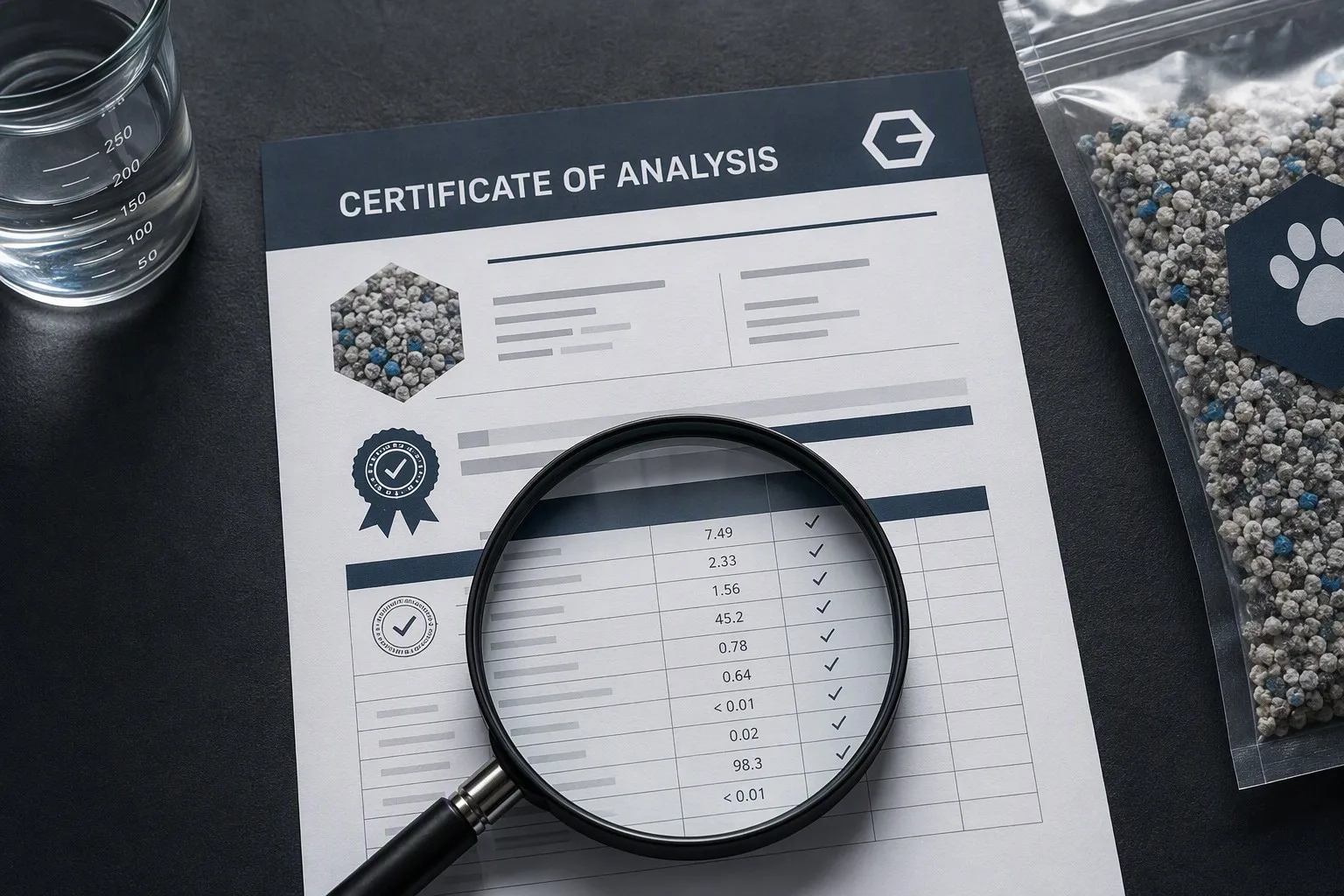
| ☐ | Batch COA (full indicator suite) | Product identity, moisture, dust, particle size |
| ☐ | Aflatoxin B1 test report | Safety — plant-based materials |
| ☐ | OECD 301B biodegradation test report | Biodegradability screening data |
| ☐ | EN 13432 certification (if compostability claimed) | Industrial compostability — scope must be verified |
| ☐ | Ecotoxicity screening (heavy metals + OECD 208) | Compost/environmental safety |
| ☐ | Third-party lab accreditation certificate | Report credibility (CNAS/ilac-MRA) |
| ☐ | Raw material traceability record | Source verification, non-GMO status if claimed |
| ☐ | Formula disclosure (binders, fragrances, additives) | Needed to assess scope of any biodegradation/compostability test |
Note: This checklist is a procurement reference tool. Each document's legal sufficiency for packaging claims must be assessed by qualified counsel in the target market.
6. More Topics in Our OEM Guide Series
- How to Read a Cat Litter COA: 8 Indicators Importers Must Check
- How to Verify Low-Tracking Cat Litter: 4 Test Methods for Importers
- Private Label Cat Litter: Complete OEM Guide for Importers
- How to Quote Cat Litter Ocean Freight Without Losing Margin
- Tofu Cat Litter — OEM Manufacturer
- Cassava Cat Litter — OEM Manufacturer