
Cat Litter Liters vs Kilograms: Why the Unit Decides Your Quote
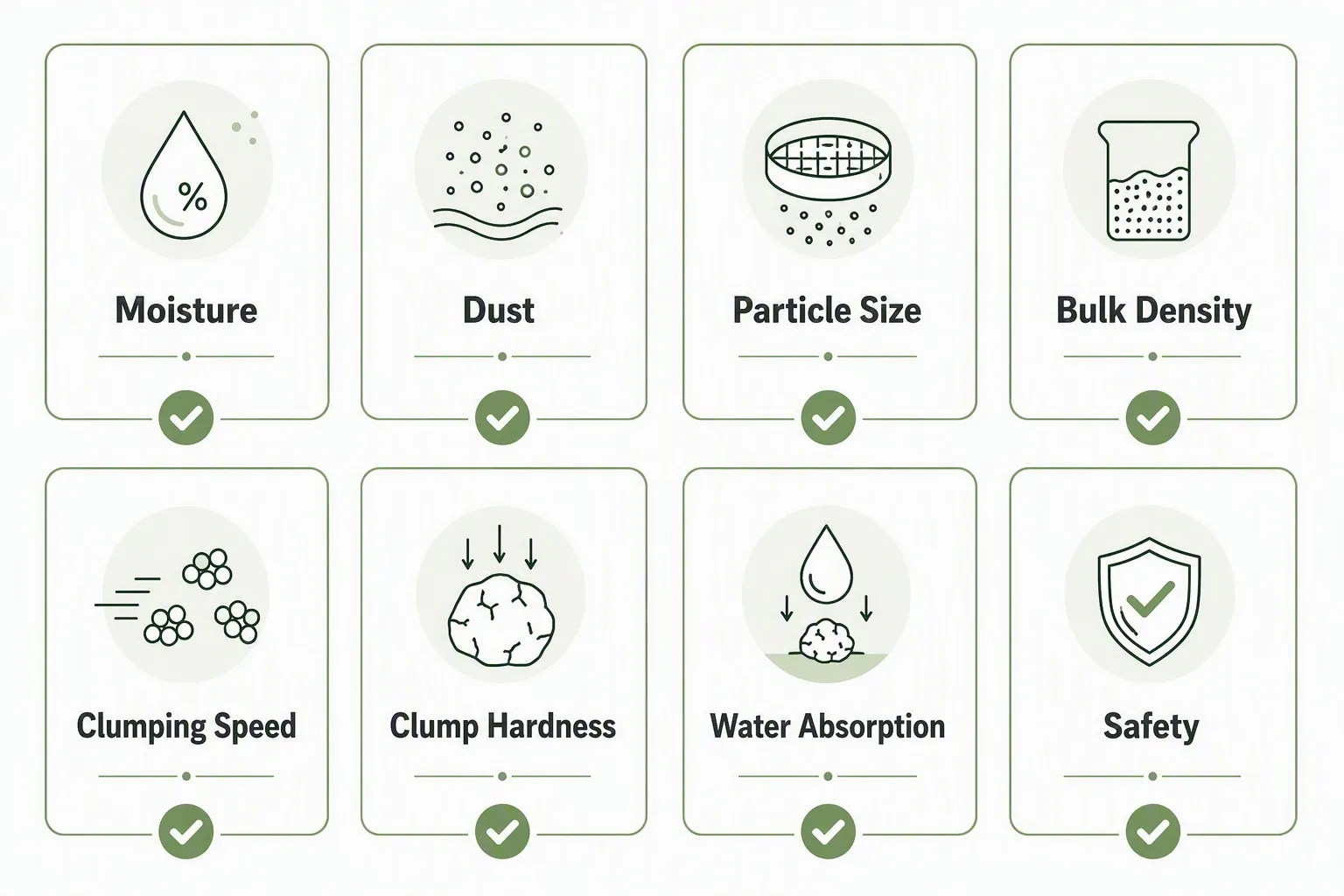
Liters and kilograms are bridged by one number: bulk density. A 5-litre bag of bentonite weighs about 4.7 kg; a 5-litre bag of tofu weighs about 3.0 kg. Same volume, different weight — and a supplier who quotes in liters while another quotes in kilograms is handing you two numbers you cannot compare without the density in the middle.
Who this is for: importers comparing OEM quotes, distributors switching bag-size formats, and anyone who has seen a tender ask for both "30L bags" and "6kg bags" and wondered which is which. The unit choice decides your quote comparison, your container math and your shelf story — and it is the field most RFQs get wrong.
1. The Unit Trap in Cat Litter Buying
Retail and B2B channels use different conventions: EU shelves sell by volume (liters, e.g. 30L bags), while US and many tender documents use weight (kg or lb). Neither is wrong — but a quote that states only one unit leaves the comparison open to a density gap. The correct quote states both units plus the density, so the buyer can verify the bag size, the weight and the per-unit economics in one line.
2. The Conversion: One Number Bridges L and kg
The bridge is bulk density in kg/L (equal to g/cm³ and to t/m³). Conversion: kg = liters × density (kg/L).
| Material | Reference bulk density (loose) | 5-litre bag weight | 30-litre bag weight |
|---|---|---|---|
| Bentonite (sodium-modified) | ≈ 0.95 kg/L (950 g/L) | ≈ 4.7 kg | ≈ 28.5 kg |
| Tofu / pea fiber | ≈ 0.60 kg/L (597 g/L, CTI) | ≈ 3.0 kg | ≈ 18.0 kg |
| Cassava / tapioca | 0.60–0.65 kg/L | ≈ 3.1 kg | ≈ 18.8 kg |
Unit conversions you will meet in specs: 1 g/cm³ = 1 kg/L = 1,000 kg/m³ = 1,000 g/L. So 950 g/L = 0.95 kg/L = 950 kg/m³ = 0.95 g/cm³ — one density, four spellings, one number. For the full math and container tables, see our bulk density guide.
3. Why Densities Differ — and the 0.85 kg/L Search
Real search data from Google shows buyers querying specific values — including "bentonite cat litter bulk density 0.85 kg/l". Why 0.85 and not 0.95? Because density is not a fixed property of "bentonite": it changes with
- Formulation — sodium vs calcium modification, filler content;
- Particle size — finer granules pack tighter;
- Moisture — absorbed water adds weight without adding volume;
- Test method — loose (untapped) density is lower than tapped density, and quoting one while selling the other is a known shortcut.
The disciplined answer is not to promise one number but to publish the reference range + method + batch rule: our bentonite TDS shows 0.85–1.05 g/cm³ with the tapped method, and the reference loose value is about 0.95 kg/L. Every shipment carries a batch COA with the measured value. See the bentonite page for the spec table and how to read a COA for the verification checklist.
4. How the Unit Changes Your Container
Containers are limited by weight and by volume. Dense litter hits the weight limit first; light litter hits the volume limit first:
| Product | 20ft loading | Limiting factor |
|---|---|---|
| Bentonite (0.95 kg/L) | ≈ 26 t | Weight (volume ~27 m³) |
| Tofu (0.60 kg/L) | ≈ 18 t per SKU | Volume (~30 m³ at 18 t) |
| Cassava (0.60–0.65 kg/L) | ≈ 18 t per SKU | Volume |
That is why the public wholesale MOQ matrix and the MOQ definitions separate bentonite (26 t/20ft) from plant-based lines (18 t per SKU): the unit of comparison is the container, not the bag. A quote converted from L to kg without density can misstate the per-container economics by a wide margin.
5. The RFQ Fields That Force a Like-for-Like Quote
Add these six fields to your RFQ so every supplier answers in the same language:
| # | Field | Why it matters |
|---|---|---|
| 1 | Bag size in L and kg | Forces both units to be stated |
| 2 | Bulk density with method | Loose vs tapped; method stated |
| 3 | Density measurement point | At loading vs at destination (moisture drift) |
| 4 | Moisture % at loading | Explains weight differences between batches |
| 5 | Container loading by product | Weight- vs volume-limited |
| 6 | Batch COA per shipment | The authoritative density record |
6. Shelf Story: Lighter Bag or Heavier Bag?
Consumers lift the bag. A 30L bentonite bag at ~28.5 kg is a two-hand carry; a 30L tofu bag at ~18 kg is not. In price-per-kilo markets the heavier bag wins the value story; in premium and e-commerce markets the lighter plant-based bag wins on carry and shipping cost. Density is the reason the same "30L" label can mean two different products on the shelf.
7. Frequently Asked Questions
Why do some suppliers quote in liters and others in kilograms?
It is a market convention, not a spec. EU retail often uses liters; US and many B2B channels use kilograms or pounds. The two units are bridged by bulk density: kg = liters × density. A quote without the unit and the density is incomplete.
How do I convert liters to kilograms for cat litter?
Multiply the volume by the bulk density: kg = L × (density in kg/L). Bentonite at 0.95 kg/L fills a 5-litre bag with about 4.7 kg; tofu at 0.60 kg/L fills the same bag with about 3.0 kg. Use the loose value measured on the actual product, with the method stated.
What is the bulk density of bentonite cat litter in kg/L?
Our batch TDS reference is about 0.95 kg/L (950 g/L, loose). Real buyer searches include 0.85 kg/L — densities differ by formulation, particle size, moisture and method. We do not fix a single number: each shipment carries a batch COA with the measured value and method.
Is a 5-litre bag of tofu lighter than a 5-litre bag of bentonite?
Yes — roughly 3.0 kg vs 4.7 kg at reference densities. Consumers notice when lifting, and the same difference shows up in pallet weight and container math.
Which unit should my quote use?
Both, plus the density: price per bag, bag size in L and kg, bulk density (loose, with method). This makes quotes comparable and prevents unit games.
Does liters vs kilograms change container loading?
Yes. Dense litter hits the weight limit first (bentonite ≈ 26 t on a 20ft); light plant-based litter hits the volume limit first (≈ 18 t per SKU). Converting without density misstates per-container economics.
What density value should I put in the contract?
A reference range plus the method and the batch rule — e.g. loose density per batch COA, reference 0.85–1.05 kg/L for bentonite. Never sign a single fixed density number; the batch COA is the authoritative document per shipment.
SilkPet Bulk Density Guide — g/L, container math and weight-vs-volume economics
SilkPet COA Guide — reading density on a batch COA
SilkPet Bentonite Page — spec table (0.85–1.05 g/cm³, tapped method)
SilkPet Tofu Page — CTI third-party density 597 g/L
SilkPet Wholesale Page — MOQ and container matrix
SilkPet Shipping Cost Guide — container freight and PSS
SilkPet MOQ Guide — five MOQ definitions
Real search evidence: Google Search Console queries include "bentonite cat litter bulk density 0.85 kg/l" (captured August 2026, query-level data).