The Ultimate Guide to Different Types of Cat Litter (2026): Pros, Cons & How to Choose
Who this is for: Pet brand owners, distributors and importers choosing which litter type to launch — and retailers who need to explain the difference to customers.
Choosing a cat litter type is a decision with real commercial consequences: the wrong type means more returns, more complaints and a dead SKU. After a decade of manufacturing all six types below, one pattern is consistent — most brand owners choose a litter type because their competitor sells it, not because the data says it fits their market. This guide fixes that. For each of the six main types, you get the honest pros and cons, the factory-level performance data, and the markets where each type actually wins.
How to Read This Guide: The 4 Decision Dimensions
Every litter type is a trade-off across four dimensions. Score your market against these before looking at any product:
| Dimension | What It Means | Question to Ask |
|---|---|---|
| Clumping vs. non-clumping | Clumping litter forms solid clumps for daily scooping; non-clumping absorbs into crystals or granules for less frequent changes | Does my target customer scoop daily or want minimal maintenance? |
| Dust level | Dust is the #1 return driver and the #1 health complaint (respiratory, fur tracking) | What dust level can my price point support? (Premium grades run ≤0.05–0.1%) |
| Odor control | Days of odor suppression per bag — 5–7 days is entry-level, 7–10+ is premium | How many cats per household in my market? |
| Maintenance cost | Bag price × bags per month = real cost to the consumer; silica lasts 2–4 weeks, clumping litter needs refills | Am I selling on price-per-bag or price-per-month? |
Now, the six types — from the highest-volume to the most specialized.
1. Sodium Bentonite Clay Litter
Bentonite is the global workhorse — the fastest clumping type, made from sodium bentonite clay that expands and bonds when wet. It dominates the Middle East, Africa and South America because it is cheap per kilo, clumps hard, and tolerates hot, dry warehousing well.
| Pros | Cons |
|---|---|
| Fastest clumping (≤3s for premium grades) | Heavy — higher freight cost per bag |
| Strong clump hardness — easy scooping | Dust risk if dedusting is skipped (5–8% yield loss is the price of quality) |
| Lowest cost per kilo in the category | Not flushable; landfill disposal in most markets |
| Odor control 5–7 days with additives | Tracking outside the box (small particles) |
Best-fit markets: Middle East, Africa, South America, mass retail in North America. Best-fit buyers: multi-cat households, price-sensitive markets, distributors moving high volume. If your brand targets eco-conscious consumers, skip this type — see below.
2. Tofu Cat Litter
Tofu litter (made from pea fiber and starch binders) is the flushable, biodegradable alternative. It disperses in water instead of clogging pipes, which makes it the default choice for Japan, Europe and North American eco channels — and it is the fastest-growing segment in the plant-based category.
| Pros | Cons |
|---|---|
| Flushable and biodegradable (when properly tested) | Higher cost per kilo than bentonite |
| Very low dust (≤0.05% in premium grades) | Quality varies enormously by binder system |
| Lightweight — freight advantage | "Sticky bottom" and clump breakdown in poor formulas |
| Customizable scent, color and pellet size | Flushable claims need certification (EN 13432 / OECD 301B) |
Best-fit markets: Japan, Europe, North America eco channels, premium pet boutiques. Best-fit buyers: eco-conscious households, apartment dwellers with flushable plumbing, single-cat households.
3. Cassava Cat Litter
Cassava litter is the soy-free premium plant-based option. Its claim to fame is absorption — a good cassava product absorbs roughly 300% of its weight, meaning less litter per refill — plus lighter weight and a fine texture cats often prefer.
| Pros | Cons |
|---|---|
| Highest absorption in the plant-based category (~300%) | Premium price point — needs premium packaging to match |
| Soy-free — wins allergen-aware consumers | Electrostatic properties need processing control |
| Lightweight — significant freight savings vs bentonite | Smaller supply base than tofu or bentonite |
| Fine texture, low tracking | Aflatoxin control critical (starch-based raw material) |
Best-fit markets: North America premium retail, Europe, Japan, allergen-aware segments. Best-fit buyers: premium brands, health-conscious households, consumers who dislike soy.
4. Silica Gel Crystal Litter
Silica gel is the lowest-maintenance type: crystals absorb moisture directly, so one bag lasts 2–4 weeks versus days for clumping litter. It does not clump — you remove solids and stir, replacing the whole box every few weeks. Premium grades add a color-change saturation indicator.
| Pros | Cons |
|---|---|
| Lowest maintenance — one bag lasts 2–4 weeks | No clumping — solids must be removed daily |
| Excellent odor control (7–10+ days with fragrance) | Non-biodegradable; landfill disposal |
| Nearly dust-free (≤0.05%) | Some cats dislike the crystal texture |
| Color-change indicator = visible "time to change" signal | Premium price per bag (offset by long life) |
Best-fit markets: USA, Canada, Western Europe, Japan, Korea. Best-fit buyers: single-cat households, busy professionals, seniors, anyone who hates daily scooping.
5. Mixed / Blended Cat Litter
Mixed litter combines two or more base materials to fix each other's weaknesses — tofu for flushability plus bentonite for clump speed, cassava for absorption plus pea fiber for structure. It is the category where private label brands differentiate, because the blend ratio is your formula.
| Pros | Cons |
|---|---|
| Engineered to combine strengths (e.g., clump speed + flushability) | Higher unit cost than single-material litter |
| Your unique blend = your brand story | Blend ratio stability must be QC-controlled batch to batch |
| Customizable for regional preferences | More complex COA (each component must be tested) |
| Can launch with a smaller order (market-test friendly) | Consumer education needed at retail |
Best-fit markets: Premium retail, markets where your competitor is already a single-material brand. Best-fit buyers: private label brands looking for differentiation, distributors testing regional preferences.
6. Health Monitoring Cat Litter
Health monitoring litter embeds detection chemistry — pH-sensing granules and occult-blood test particles — that screen for early urinary issues (FLUTD, crystals, infections). It is the most specialized type, sold through veterinary channels and premium health-focused retailers at the highest margins in the category.
| Pros | Cons |
|---|---|
| Highest margin in the category | Niche demand — education required |
| pH and blood detection = real health value | Detection chemistry must be lab-validated |
| Color-change signal is intuitive for owners | Higher cost per bag |
| Vet-channel credibility builds brand trust | Not a "first cat litter" — an upgrade product |
Best-fit markets: North America, Western Europe, veterinary distribution. Best-fit buyers: vet clinics, premium health brands, senior-cat households.
Comparison at a Glance
| Type | Clumping | Dust | Odor Control | Maintenance | Best Markets |
|---|---|---|---|---|---|
| Bentonite | ≤3s (premium) | ≤0.1% | 5–7 days | Daily scoop + refill | MENA, Africa, LATAM |
| Tofu | ≤5s | ≤0.05% | 7–10 days | Daily scoop; flushable | Japan, EU, NA eco |
| Cassava | ≤4s | ≤0.05% | 7–10 days | Less refill (300% absorption) | NA premium, EU, JP |
| Silica gel | Non-clumping | ≤0.05% | 7–10+ days | 2–4 weeks per bag | USA, Canada, WEU |
| Mixed | Formula-dependent | ≤0.05% | Formula-dependent | Formula-dependent | Premium retail |
| Health | Varies by base | Varies | Varies | Daily scoop + monitoring | Vet, NA, WEU |
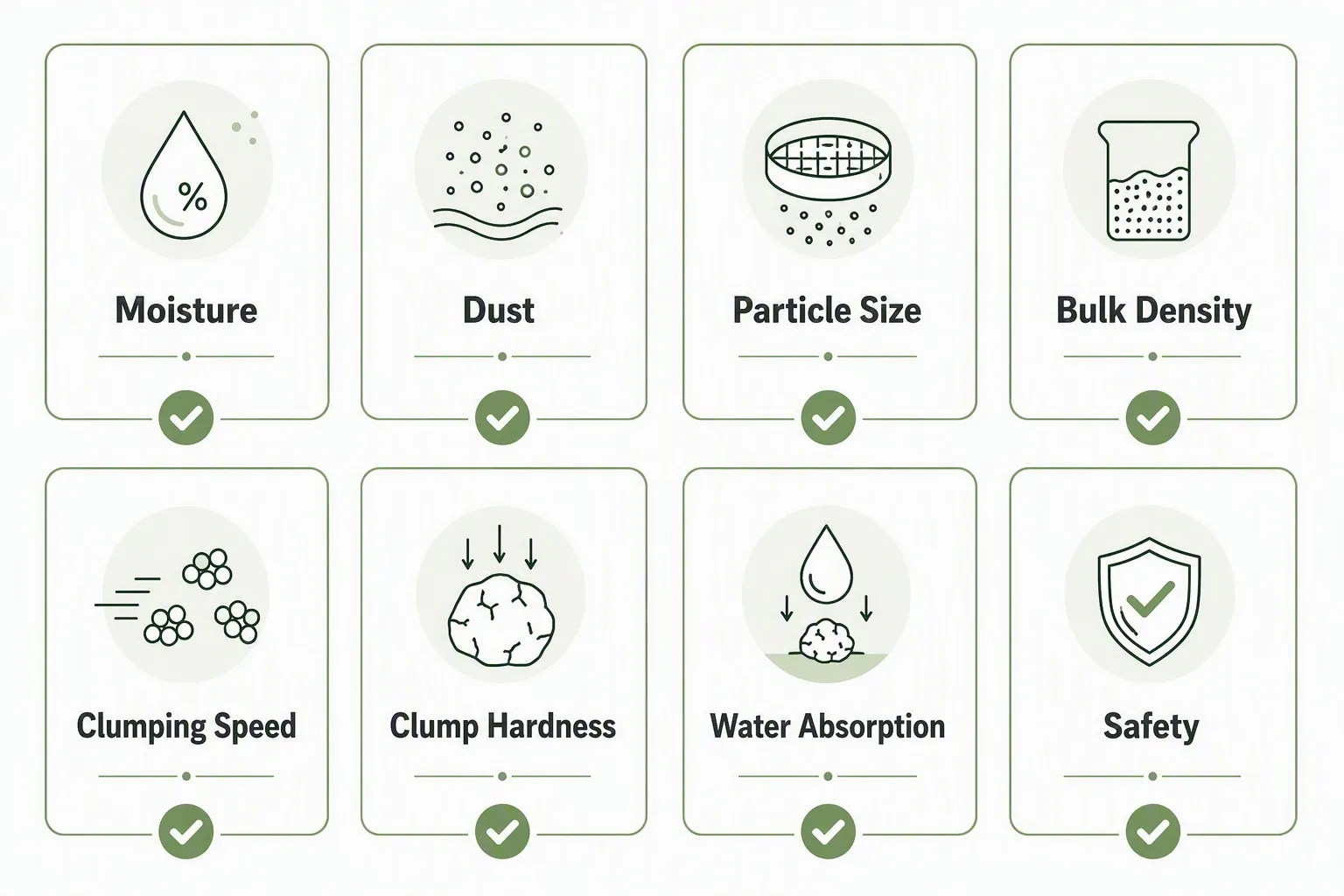
The figures above are Jinan Silk Pet factory reference ranges. Whatever type you choose, verify the factory's numbers with the eight-point framework in our factory evaluation guide before committing.
How to Choose: Scenarios
| Your Scenario | Recommended Type | Why |
|---|---|---|
| Multi-cat household, budget market | Bentonite | Fastest clumping, lowest cost per kilo, hard clumps survive heavy use |
| Eco brand, apartment market | Tofu (flushable) | Biodegradable, flushable, low dust — matches eco positioning |
| Premium allergen-aware brand | Cassava | Soy-free, highest absorption, justifies premium shelf price |
| Low-maintenance positioning | Silica gel | 2–4 weeks per bag is the single easiest retail story |
| Differentiation / first product | Mixed blend | Your own ratio = your own brand; test 2–3 blends in one container |
| Vet channel, senior cats | Health monitoring | Highest margin; detection value is easy for vets to explain |
Frequently Asked Questions
What are the different types of cat litter?
The six main types are: sodium bentonite clay litter (fastest clumping, highest volume), tofu litter (flushable, biodegradable), cassava litter (highest absorption, soy-free), silica gel crystal litter (lowest maintenance, 2–4 weeks per bag), mixed/blended litter (custom ratios for specific needs) and health monitoring litter (pH and blood detection for early urinary screening).
Which cat litter type clumps the fastest?
Sodium bentonite is the fastest clumper — factory-tested clumping speeds are typically 3 seconds or less for premium grades. Tofu and cassava litter clump in 4–5 seconds. Silica gel crystal litter does not clump at all — it absorbs moisture into the crystals instead, which is why one bag lasts 2–4 weeks.
Is tofu cat litter flushable?
High-quality tofu cat litter is designed to be flushable and biodegradable — it disperses in water instead of clogging pipes. But flushable claims must be tested, not assumed: check the factory's testing against standards like EN 13432 or OECD 301B before printing the claim on your packaging, and confirm local municipal rules in your market.
What is the best cat litter for odor control?
For long-lasting odor control with minimal maintenance, silica gel crystal litter is the best performer — one bag lasts 2–4 weeks and premium grades include color-change saturation indicators. For daily scooping households, clumping bentonite with odor-control additives (7–10 days of odor suppression) is the most popular choice. The best type depends on whether you prefer low maintenance or daily scooping.
Can I mix different types of cat litter?
Yes — mixed or blended litter is a category of its own. Common commercial blends combine tofu with bentonite (clumping speed plus flushability), cassava with pea fiber (absorption plus light weight), or mineral with plant-based granules. Factories like ours produce custom blend ratios to your specification, which is a practical way to differentiate a private label brand.
Bottom line: pick the litter type for your market, not for your competitor. The data in this guide — clumping speed, dust, odor control, maintenance — is the same data we print on our product pages, and the same data you should demand from any factory's COA. If you are still deciding between two types, order samples of both and run the four low-cost tests in our verification guide — or message us on WhatsApp and we will send both for free.