Cat Litter QC Checklist for Private Label: 18 Checks Before You Commit
Who this is for: private label brands and distributors about to sign a cat litter supply agreement, and anyone who has ever received a beautiful sample and a disappointing container. The gap between those two moments is quality control — and most of it can be checked before you commit.
This checklist is grouped into four stages: sample evaluation (5 checks), production (5 checks), pre-shipment (4 checks) and contract (4 checks). Every check names the document or test to request, so you can run it without trusting a supplier's word. We run our own batch COA program to these standards — the numbers on our product pages are batch-verified, not brochure values.
Stage 1 — Sample Evaluation (5 checks)
The sample is the cheapest insurance you will ever buy. But a sample is only useful if it represents the product you will actually receive.
| # | Check | What to request / do |
|---|---|---|
| 1 | Batch-linked sample | Ask for a sample taken from a real production batch, with the batch number written on the bag or the COA — not a specially prepared show sample |
| 2 | Moisture | Batch COA moisture value (oven-dry method); below 8% for plant-based lines, above 10% is a red flag for sea freight |
| 3 | Dust with method | Dust value with the test method stated (e.g. ISO 8130 sieving); pour from 30 cm onto a dark surface to sanity-check airborne dust |
| 4 | Clumping protocol | Time the clump with a defined water volume; drop the clump after 10 minutes to test hardness |
| 5 | Density: loose or tapped? | Confirm whether the quoted density is loose or tapped — quoting one and selling the other is a known shortcut |
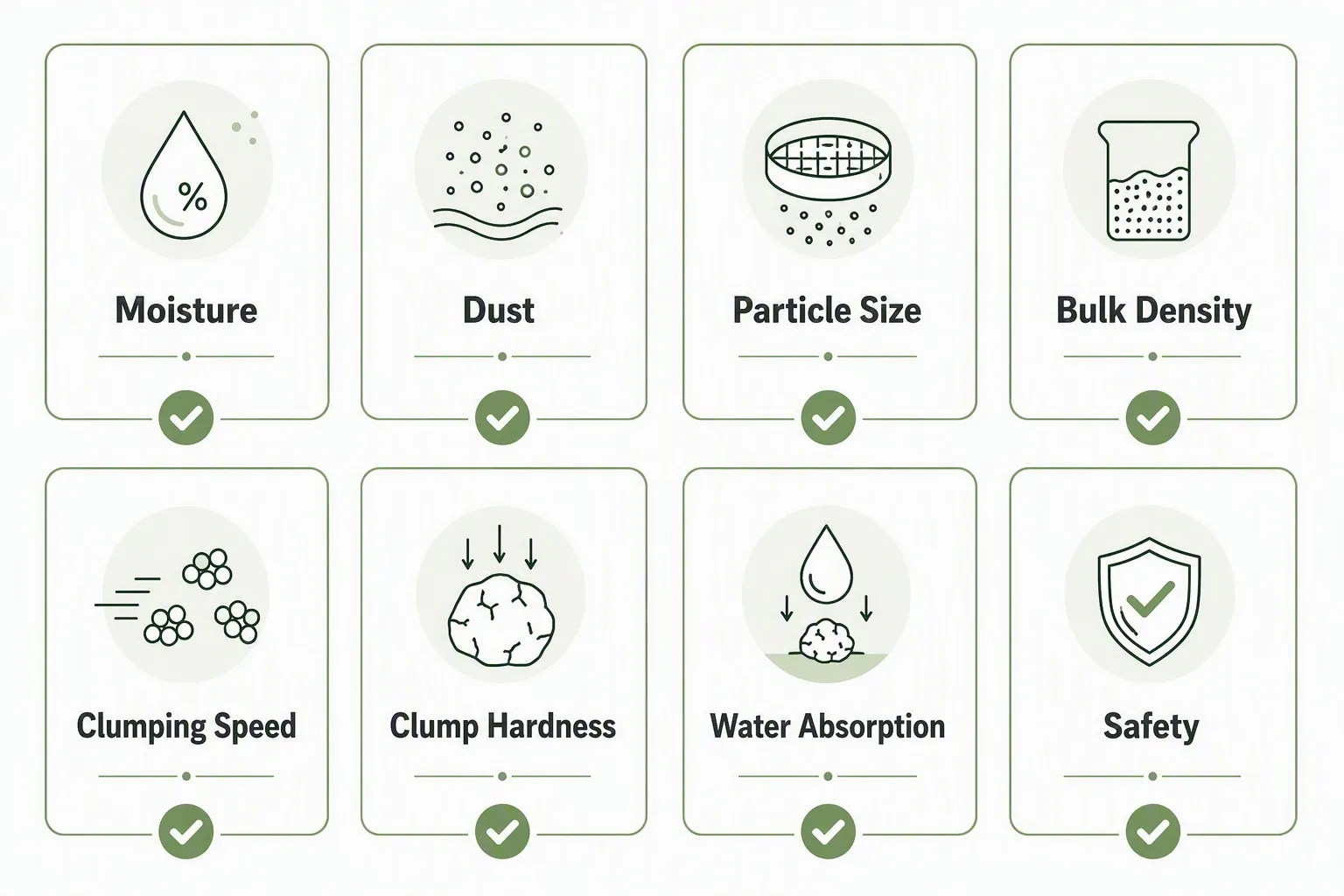
If the factory cannot produce a batch COA for the sample you hold, stop there. The COA is the document that makes samples comparable; see how to read a cat litter COA for the full eight-indicator walkthrough.
Stage 2 — Production (5 checks)
Sample quality proves a factory can make the product. Production checks prove it will, consistently, across your order.
| # | Check | What to request / do |
|---|---|---|
| 6 | Raw material intake | Ask how incoming fiber/starch/mineral is tested — moisture, purity, particle size, micro (for plant-based) |
| 7 | In-process sampling | What is the sampling interval on the line? (e.g. every 2 hours for diameter, moisture, hardness) |
| 8 | Performance gate before packing | Is there a clumping/absorption test before a batch is cleared for bagging? |
| 9 | Dust control process | How are fines removed before bagging? (screening stages, air-jet dedusting) |
| 10 | Batch traceability | Can every bag be traced to a production date and batch number? |
Our tofu line, for example, runs four-stage QC: raw material incoming inspection, in-process sampling every 2 hours, a pre-packaging performance test, and a pre-shipment microbiological test — and every batch ships with a COA. That structure is what you are auditing with checks 6–10.
Stage 3 — Pre-Shipment (4 checks)
The container is where the sample's promises are tested. Verify before the container seals, not after it arrives.
| # | Check | What to request / do |
|---|---|---|
| 11 | Pre-shipment inspection | Batch COA for the exact shipment (production date, expiry, measured parameters); third-party inspection (e.g. SGS) on request |
| 12 | Packing list & labels | Verify bag count, net weight per bag, label artwork against your approved proof |
| 13 | Container loading plan | Bags per 20GP/40HQ, pallet configuration, weight vs volume limit for your SKU |
| 14 | Moisture at loading | Moisture value measured at loading, not the value from last month's batch |
Checks 12–14 matter because plant-based litter drifts: absorbed humidity adds weight without adding volume, and a density quoted at production may not be the density at loading. Container math for your pack is on our bulk density guide and the liters vs kilograms explainer.
Stage 4 — Contract (4 checks)
The contract is the only QC document that survives the handshake. Four clauses protect your program:
| # | Check | What to put in the contract |
|---|---|---|
| 15 | Reference range + method, not one number | e.g. loose bulk density per batch COA, reference 0.85–1.05 kg/L for bentonite — never a single fixed value |
| 16 | Batch COA rule | COA per shipment with batch number, methods, and a defined dispute process if results differ at destination |
| 17 | Moisture & density measurement point | At loading vs at destination — who measures, when, and which document governs |
| 18 | Remedies | What happens on out-of-spec batches: rework, replacement, or credit — agreed before the first container, not after |
For the MOQ and payment structure side of the contract, see our MOQ guide; for the supplier claims that need verifying in the first place, see how we verify low-tracking claims.
Batch Traceability Table: Your Brand's QC Backbone
For a private label brand, the quality story is told in batches, not in brochures. Set up this traceability table from the first container — it is the file that answers a retailer audit, a customs question or a customer complaint in minutes instead of weeks:
| Column | What to record | Why it matters |
|---|---|---|
| Batch number | Factory's batch ID printed on the COA | Links the shipment file to the physical goods |
| Production date | Date of manufacture | Age of product at arrival; moisture risk window |
| COA values + methods | Moisture, density, dust, clumping — with the method named | Measured facts, not brochure claims |
| Container / B/L reference | Container number and bill of lading | Locates the batch in transit and at port |
| Retained sample status | Sealed sample location and expiry of hold | Evidence for disputes and re-tests |
| Disposition | Released / reworked / quarantined | Shows the batch was checked, not just shipped |
One file per shipment. When the factory sends the batch COA, drop it into this table with the container reference and a photo of the sealed retained sample. After three shipments you will have a quality history that makes your brand audit-ready — and that most competitors importing from China simply do not keep.
Frequently Asked Questions
What should I check when comparing cat litter factory samples?
Ask for a sample from a real production batch with the batch number on the bag or COA, then verify moisture, dust with method, clumping speed and clump hardness, particle size, and loose vs tapped density. Record every value on the batch COA.
Which QC documents should a cat litter factory provide?
A batch COA per shipment with methods, a TDS with reference ranges, third-party reports where available (CTI or SGS), and market certificates such as ISO 9001, HACCP, HALAL or SMDS. A factory that cannot name its test methods is a red flag.
What is the difference between a COA and a TDS?
A TDS describes the product and its reference ranges; a COA documents what a specific batch actually measured, with batch number and methods. For procurement, the batch COA is authoritative.
How do I verify a supplier's clumping and dust claims?
Request the batch COA with the method stated, then test the physical sample under the same conditions: fixed pour height, timed clump, 10-minute drop test, and sieving for fines. Our low-tracking guide documents the four-test protocol we use.
What moisture level is safe for sea freight?
Below 8% for plant-based litters such as tofu and cassava; above 10% is a red flag. The figure must come from the batch COA and be read with the density on the same document.
Should I sign a contract with a fixed density or clumping number?
No — put a reference range plus method and a batch rule in the contract. A single fixed number cannot hold across formulations, moisture and seasons.
Cat Litter Wholesale Philippines — importer's guide to the first container
Cat Litter COA: 8 Indicators for Importers — how to audit batch test data
Cat Litter Low-Tracking Verification — four-test protocol
Cat Litter Bulk Density — g/L, container math, loose vs tapped
Cat Litter Liters vs Kilograms — unit conversion and RFQ fields
Cat Litter MOQ Explained — five MOQ definitions
SilkPet Tofu Page — four-stage QC process and CTI batch data
SilkPet Bentonite Page — spec table with ISO 8130 dust method