
Cat Litter Sourcing: Stop Obsessing Over the Factory Price. Inland Logistics and Industrial Infrastructure Are the Real Costs You Don’t See
A Middle Eastern client told me something last year.
He was looking at two bentonite cat litter factories in China. On an EXW basis, one was nearly $8 per ton cheaper. His instinct was to go with the cheaper one. Then he broke down the costs between EXW and FOB himself. The cheaper factory was deep inland, over 700 kilometers from the port. The trucking cost was significantly higher, and the risk of trucks getting stuck during peak season was real. The slightly more expensive factory was just over 400 kilometers from the port, had a stable fleet, and could get the container into the terminal the same day it was loaded.
Once he pulled both quotes all the way from EXW to FOB, the cheaper factory was actually more expensive.
He told me: “I thought I had found a price advantage. Then I realized that advantage was just an illusion created by the freight differential.”
Cat litter is heavy freight. A container of bentonite weighs over a dozen metric tons. Tofu and cassava litter are lighter, but you’re still dealing in tons. An attractive EXW price can be completely eaten alive—or even reversed—by the inland costs from the factory to the vessel. This article breaks down that math. Whether you’re looking for a cat litter supplier, a cat litter manufacturer, or comparing quotes from different cat litter factories in China, this will help you get the numbers straight.
EXW Cheap Doesn’t Mean FOB Cheap. The Gap Is Hundreds of Dollars
Let’s clarify the two terms first.
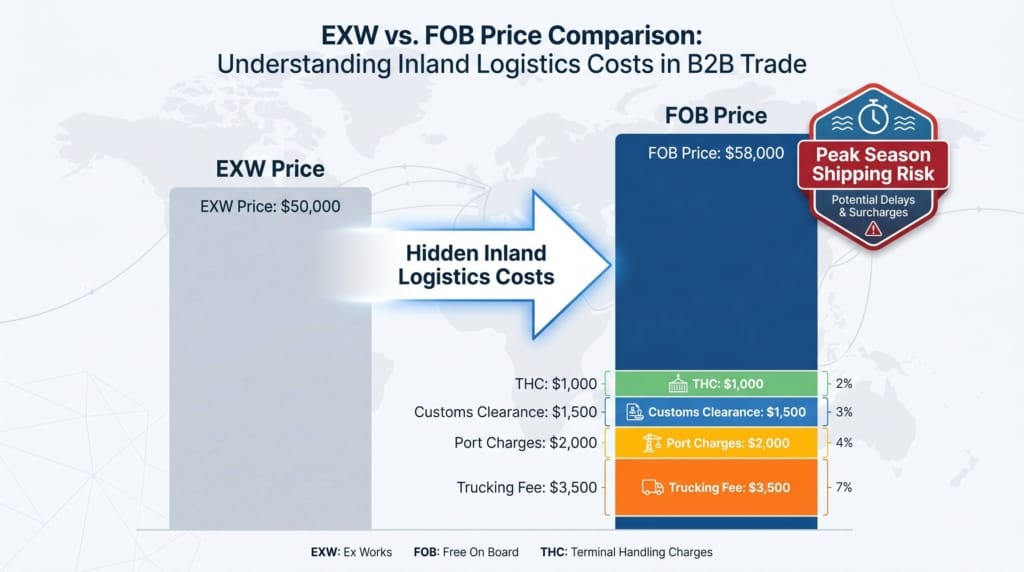
EXW is the price at the factory gate. The goods are yours to move. You handle the trucking to the port, customs declaration, and loading. The factory doesn’t cover inland transport.
FOB is the price loaded on board the vessel. It includes the trucking from the factory to the port, customs brokerage, and terminal handling charges—everything up to the point the cargo crosses the ship’s rail. The gap between a cat litter FOB quote and an EXW quote is the true cost of inland logistics.
A few dollars cheaper on EXW looks tempting. But if the factory is deep inland—say 400 to 500 kilometers from the port—the trucking fees plus port miscellaneous charges can easily add over a dozen dollars per metric ton. Those few dollars you saved on EXW won’t come close to covering the extra transport costs that follow.
And inland freight doesn’t scale linearly. Within 500 kilometers, trucking rates are relatively stable; that’s the standard transport radius. Beyond 500 kilometers, the round trip takes longer, the risk of congestion during peak season jumps, and the chance of a return trip with no cargo is high. Rates spike and timelines become less reliable. Inland costs on a single container can vary by hundreds of dollars.
You feel like you’ve found a bargain when you compare EXW prices. You realize you haven’t when you compare FOB. That’s why experienced cat litter wholesalers and distributors don’t just look at EXW. They ask for the FOB price straight away—and then they break down every line item.
Beyond the Trucking Fee, There Are Several More Bills to Pay
Inland logistics isn’t just the trucking fee. When a factory quotes FOB, that number includes at minimum: port miscellaneous charges, terminal handling charges, customs brokerage, and documentation fees. Some ports also charge port construction fees and security fees.
If there’s no established container depot near the factory, empty containers have to be hauled in from farther away, and that repositioning fee is another cost. During peak season, ports get congested. Trucking queues bill waiting time by the hour. A factory with a well-coordinated fleet can beat the rush. One that’s slow to schedule will have containers waiting outside the terminal, racking up charges.
Whether the factory has long-term relationships with local freight forwarders and trucking companies makes a big difference. Long-term partners mean faster dispatch, transparent pricing, and priority during peak season. Finding trucks and containers on the spot every time means higher costs—and sometimes no truck at all when demand is high. Some of the cost differences between LCL and FCL shipments for cat litter are hidden right here.
If you’re sourcing cat litter from China for the first time, or reevaluating whether an existing supplier’s wholesale price is reasonable, breaking out these cost items is far more useful than just comparing bottom-line numbers.
Local Industrial Infrastructure Determines Supply Stability
Cat litter isn’t an isolated factory product. It requires packaging materials, additives, equipment spare parts, and testing services. Whether these supporting industries are nearby directly determines a supplier’s delivery speed and production flexibility.
If a bentonite litter factory has a packaging bag manufacturer next door, the bag order lead time can be cut in half. If you’re doing private label cat litter or custom packaging, the speed of packaging supply determines your time to market. If additive suppliers—activated carbon, guar gum—are in the same industrial park or a neighboring city, restocking takes days, not months of inventory sitting in the warehouse.
Tofu cat litter and cassava cat litter depend even more on industrial clustering. The supply radius for soybean fiber or cassava starch determines both the freshness of the raw material and its transport cost. If there’s a large soybean processing or cassava industry near the factory, raw materials can be sourced as needed. If raw materials have to be trucked in from hundreds of kilometers away, both quality and supply stability carry extra risk.
China’s cat litter industry has several concentrated production zones. Around these zones, raw material suppliers, packaging factories, trucking fleets, and third-party testing labs are all in place, forming a complete industrial ecosystem. A factory inside this ecosystem benefits from lower procurement costs, faster delivery, and better technical exchange. A factory far from the cluster—one standing alone—pays more to bring raw materials in and ship finished products out. It’s also less resilient when raw material prices swing or peak season orders pile up.
When evaluating a supplier, ask them a few questions:
- How many packaging material suppliers are in your area?
- What’s the supply radius for your core raw materials?
- Roughly what’s the scale of the local cat litter industry?
A supplier who can talk through these openly is operating inside an ecosystem. One who can’t is going it alone—and the probability of things going wrong during peak season or raw material fluctuations is higher.
This is especially important for buyers doing OEM cat litter or custom formula cat litter. OEM orders involve formula adjustments, packaging sampling, and additive matching. The more complete the surrounding infrastructure, the shorter the sampling and adjustment cycle.
How to Apply This When Selecting a Supplier
Before you compare prices, map out the supplier’s geography and surrounding infrastructure.
Ask them to break down the costs between EXW and FOB:
- How much is trucking?
- How much are the port charges?
- How much is customs brokerage?
Then ask:
- What is the distance from the factory to the nearest outbound port?
- What is the common transport route?
- Have they had trucking delays during peak season?
- How far away are their packaging suppliers and raw material vendors?
- How are core additives supplied?
- What does the local cat litter industry scale look like?
Put this information alongside the factory price. What you’re evaluating is total cost and supply stability, not a single number on a quote sheet.
A factory 400 kilometers from the port, with a full set of local supporting industries and mature logistics partnerships, versus a factory 700 kilometers from the port with nothing around it—a few bucks cheaper on EXW means nothing. By the time you pull the numbers to FOB, the total cost advantage may already be pointing the other way.
Whether you’re from the Middle East, South America, or Africa looking for a cat litter supplier in China, this evaluation framework applies. The cost structure of bulk cat litter shipping is never just about the factory price.
A Few Last Points
Cat litter sourcing isn’t a contest of who wins a few dollars on an EXW price list. It’s about no stockouts all year, no delays at the port, and holding steady through peak season. Behind those capabilities is more than factory production management. The fundamentals of geography and local industrial infrastructure set the supplier’s supply elasticity and your true cost from day one.
Next time you visit a factory in China, don’t just stare at the production line. Ask the supplier to pull up a map. Have them point out where the factory sits, where the nearest outbound port is, where the raw materials come from, and where the packaging bags are made. Figuring that out tells you more about a supplier’s reliability than watching a production line ever will.
If you’re currently comparing quotes from suppliers in different production regions and you’re not sure if the EXW-to-FOB numbers add up, send the quotes over. We’ll break down each line item for you. You decide if it makes sense.